Showing posts with label 1978. Show all posts

Wednesday, 11 September 2013

The Power of Kroll

Oh no, I spoke to soon. What is amazing about ‘The Power of Kroll’, is not that after four great stories we are sadly let down, but that this script came from Robert Holmes. There are several reasons why this story gets a fail, but some of the blame must be attributed to the author sadly. ‘The Ribos Operation’, his previous contribution, is wonderful. The characters are rich in that story – even the rogues are likeable. Iin this one they are either functional, insignificant or just angry. Take the two main characters in point – Rankin, leader of the ‘swampies’ played by John Alberni, back again for his third story, and Thawn, in charge of the methane plant, played by Neil McCarthy (who was also in ‘Mind of Evil’). They are just angry characters, who remains unchanged by any circumstances, wanting to kill either the humans or the Swampies.
Kroll towers over the Swampies

Then we have John Leeson and sadly Philip Madoc in purely functional roles, and Glynn Owen as gun-runner Rohm Dutt, who could have been quite a character but the character isn’t fleshed out, and then is killed at the end of the second episode. A character that could have been interesting is reduced to a purely functional part.
Swampies in the ... swamp.
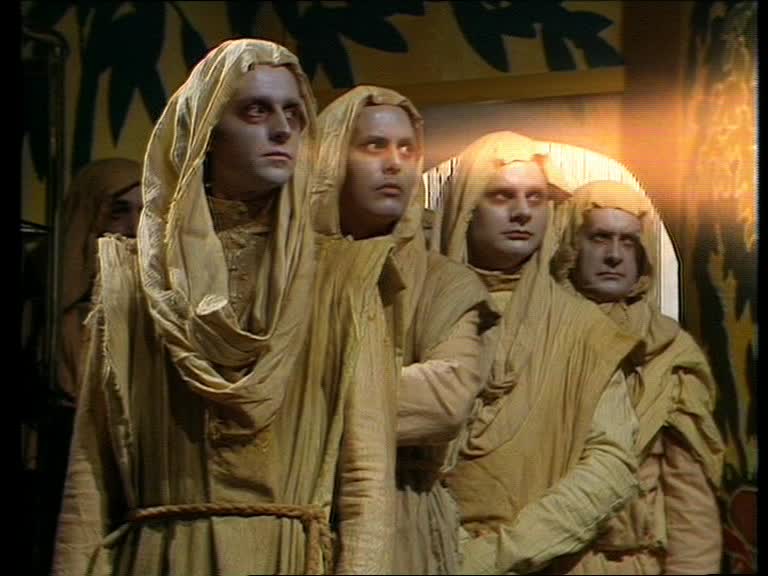
As for the swampies, you can’t help but feel sorry for the actors. They couldn’t afford costumes apparently, so they just stuck them in crappy wigs and painted their bodies green. Holmes has not devoted any time into making any of the Swampies interesting characters with considered motivations. It’s a pity  - these are the rightful inhabitants of Delta Magnor (they’ve been moved to this moon because it was overrun by humans), and it would have been  good to show them in a better light rather than just moronic savages.
There was the potential to make this very political as well, another comment on colonialism which we have had in stories such as ‘The Mutants’, but it
The Doctor, Romana and Rohm Dutt get stretched to the limit.
doesn’t explore this as much as it might have.
On a positive side, I think Kroll looks ok. It must have been difficult to do, and it is done by splitting the screen horizontally and some shots are more successful than others. It is clearly the story of the season where they’ve had to save money. There is a fair bit of location shooting for it, but aside from that it seems very cheap. There’s a limited number of sets, three sets for inside the refinery, and the room where the Doctor, Romana and Dutt were to be sacrificed to Kroll. So it’s a pity they could devote a few more pounds to make the Swampies look better, because they are seriously embarrassing.
So in short, it falls short. Very short.

3/10

Monday, 9 September 2013

The Androids of Tara

The strength so far of this season, apart from some great casting, has been the variation in stories. We go from a moody slightly comical piece with excellent characterisations to a sort of fantasy world where everything is over the top, to a dark horror story which turns into a science fiction mishmash, and then ‘The Androids of Tara’ – a delightful swashbuckling tale of knights filled with sword fights and robots, based on a story called ‘The Prisoner of Zelda’.
Mary Tamm meets Peter Jefferies.
For me this one takes the cake as the best of the season so far. And if this rate of improvement keeps up the finale of the season is going to be awesome. This is one of my all-time favourites I’d have to say. If you take away the frankly awful creature that attacks Romana in the first episode, then it’s almost perfect!
The Android Prince about to be crowned King.
The locations were perfect, as was the weather. It was filmed in the Summer, a good Summer, in England which is not the sort of weather one associates with England. Often they would find themselves shooting in the middle of winter, especially back in the Jon Pertwee days. The cast must have been relieved to be shooting outside in this sort of weather.
The plot, David Fisher’s second story in a row by the way, takes the outline from a story called ‘The Prisoner of Zelda’, which I have never read. This was Anthony Read’s suggestion to the writer I believe. Read did well to find David Fisher who had never written for Doctor Who before, and did even better to get two top-notch stories out of him. The fact that this one was not a wholly original idea doesn’t matter, it was completely Doctor Who-ised and is four wonderful episodes of TV. The nature of the story, a medieval design set on a far off planet where robotics is popular, means that this is the sort of story which stands the test of time and doesn’t come across as particularly dated.
It’s primarily shot on film too which gives it a better look than ‘The Stones of Blood’. Apart from the sparkling script, what makes this story one of the best is the cast. It’s a top notch guest cast led by Peter Jeffrey, returning to Doctor Who for his second story (his first was’ The Macra Terror’ more than ten years earlier) who plays the Count with wonderfully villainous relish. Prince Reinhart is played by Neville Jason, again perfect casting for the romantic lead of the piece. The supporting cast is also uniformly excellent, with a special appearance by Cyril Shapps in his fourth and final Doctor Who story, and it’s an extra-special one – he doesn’t get killed in this one!
So it yourself android building!
The story also features Mary Tamm doubling, or in fact tripling up as Romana, the Pirncess Strella and an android double of the Princess. In fact there’s also an android double of Romana so technically she plays four characters. From the interview on the DVD this was probably her favourite story, and she clearly enjoys it. In fact, the entire cast are clearly having a ball from go to woe. It is however, played straight, but with enjoyment. As I have said before, when the actors are enjoying themselves, we tend as an audience to also enjoy ourselves.
This is right up there with the best of the best. Season 16 has transformed Doctor Who into a fun and clever programme once more after the very poor season 15.

9.5/10

Sunday, 8 September 2013

The Stones of Blood

David Fisher enters the Doctor Who fold with the first of two stories that featured in the sixteenth season. ‘The Stones of Blood’ was the 100th overall Doctor Who story, and featured a strange but very effective mix of horror and science fiction. It’s perfectly cast and well directed and continues the improvement of season 16 over season 15.
The idea of rocks that move was always going to be one that was hard to convey without it look completely stupid, and the effects team, featuring Matt Irvine, thankfully found a way that worked without dressing people up to look like big rocks. 
Campers killed by an Ogri

Very thankfully. In fact the rocks look really good and are well shot, but I have no idea how they were made to move – I presume they attached wheels to the base and pushed them along or something. Shots of the stones moving were also kept to a minimum, always the safest way to go.
The delightful Beatrix Lehmann.
Beatrix Lehmann as Professor Amelia Rumford spearheaded the guest cast. In fact the cast was very small, but you don’t notice it at all. Besides the Doctor and Romana, only Rumford and Vivian Faye feature in all four episodes. We have Mr De Vries and his wife who get killed around episode two, and the Megari, the justice machines in the last two episodes who are just a floating special
effect which speaks. Apart from the Ogri – the moving stones, that is all the characters of note in the story, save the two campers who foolishly put their hands on a stone and get their blood sucked out.
Vivian Fey is quite the bird!
Beatrix Lehmann is wonderful. She seems to stumble over her lines at times but it just comes across as part of her character. Vivian Faye is played by Susan Engel who does a superb job – she is covered in silver paint for half the story and she certainly shines! (sorry about the joke!) Interestingly, Honor Blackman was approached initially to play the role but declined. That WOULD have been interesting!

Tom Baker shines brightly too in this story, especially in the scenes where he is defending himself against the Megari. He dons a little wig and is very eloquent indeed. This part of the story is set in a hyperspace vessel sitting, in a different dimension, just above the stone circle in a field somewhere. The sets are rather good, and the location is perfect.


It's Miss Fey!


The story does, however, suffer from being shot on OB (video). The whole look is very ‘matte’. In fact a lot of the outdoor stuff doesn’t appear to quite in focus. The idea of not shooting it on film is to give the story a uniform look, unlike the previous story, ‘The Pirate Planet’, however it still struggles to match up with the studio look and doesn’t have the definition of film. Strange that I prefer the jarring of going from film to video and back to all shot on video, but I do. Of course, the best solution would have been, in my opinion, to shoot the whole thing on film. However that would have been too expensive.
The Doctor defends himself to the Megari.
I enjoyed this story a lot, but not as much as ‘The Ribos Operation’. I’m not sure how else to explain giving it a slightly lower score. I really enjoyed the way we are suddenly in a space ship in another dimension when the whole story appeared to be going along a clear route. It’s an awfully clever, witty, scary and well-cast story.

8.5/10

Saturday, 7 September 2013

The Pirate Planet

The Doctor and Romana arrive on Zanak.
Douglas Adams is a pretty famous author, but it comes as a surprise to many that he ever wrote for Doctor Who. ‘The Pirate Planet’ came at a time just before he became properly famous. He would go on to be script editor for season 17 just as he exploded onto the scene with his classic book ‘Hitchhikers Guide to the Galaxy’ which would become a radio drama and a TV hit. Who fans though will always claim him though! Because Who came, kinda at least, first!
‘The Pirate Planet’ is perhaps the most ‘barmy’ story I have seen so far since I started watching Doctor Who. The concepts are the driving force behind just how ‘out there’ it his, with larger than
Bruce Purchase and Andrew Robertson
life comic book characters adding to the mix. At the helm of the madness is Bruce Purchase, who plays the Pirate Captain. Without a doubt, perfect casting. Ably assisted by My Fibuli (Andrew Robertson), and a nurse (Rosalind Lloyd) who doesn’t appear to do much until episode four when it is revealed she is really Queen Xanxia, an evil queen who ruled the planet Zanak for many years and whose original body is being held between time dams to hold onto the last few seconds of her life.
It's the Mentiads!
The planet jumps from world to world, encompassing that world where they suck all the mineral wealth from it before moving onto another world, by way of a giant dematerialisation circuit. It turns out that Calufrax, the world they are surrounding during this story, is actually the second segment to the Key to Time.
Got all that? Then there’s the Mentiads – a gestalt, again a sort of group being, with amazing psychic powers derived from the deaths of all the worlds the Captain has pillaged. The natives to Zanak are portrayed as pretty much morons afraid to ask questions, who have gem stones thrown at them every so often when the planet moves and the Captain announces a new ‘Golden Age of Prosperity’.

Purchase, Roaslind Lloyd and Robertson.
However, the Captain hates Xanxia, and has derived some sort of plan to kill her involving balancing the compounded remains of all the planets he’s pillaged in perfect harmony. So basically, this is not a story for the easily distracted!
How does it come up? Some parts are very good, some so-so, and some don’t work. Adams through in a lot of strange and weird ideas on top of the plot. Pennant Roberts is a good director but I think he found this all a bit of a challenge. The writer certainly asked a hell of a lot from the production team. The city – which was a little bit middle eastern in design, nice as it made a change from any city we’ve seen on another planet, then the ‘bridge’, a pretty good model from which the planet was controlled from. There was a lot of location footage, flying cars, a corridor which moves people along without walking, inside mines, outside mines, and finally the machinery for moving the planet which was shot at a power station.
The Doctor finds the real remains of Queen Xanxia. 
To be honest, it doesn’t all work that well. It is a mish-mash of locations, models and studio, of film and video. This might have been one case when shooting on OB video equipment may have helped the look of the story, but alas it was done on film. The power station didn’t look like it belonged as part of the mountain where it was housed, the city model was a nice idea but doesn’t convince, and the city streets are clearly studio floors. But the team must have been stretched to the limit.
The story also ends far too abruptly. Why? Well they appear to just have run out time. ‘Oh, no time we’ll just blow up the bridge’. The explanation of how the Doctor planned to convert the crushed Calufrax into the second segment was poor too, and audiences, (well at least me!) were dying to SEE him do it. Also, wouldn’t blowing the bridge up release the energies of the crushed planets, therefore creating a massive black hole?
The hair cuts are wonderfully seventies. The show looks dated. Oh and we have wonderfully stupid guards with very dumb helmets again covering most of the face for apparently little reason. Some of the acting is a little poor too, which is unusual for a Pennant Roberts story, but then I expect he had his hands full trying to realise everything.
Nevertheless, this is a good, challenging, clever and different story. It’s quite a breath of fresh air to be honest. The Key to Time is off to a good start after the first two tales and I look forward to more!

7/10

Friday, 6 September 2013

The Ribos Operation

Mary Tamm
Graham Williams came to Doctor Who with a plan to make a season arc called ‘The Key to Time’. However, ‘The Horror of Fang Rock’ had been commissioned and planned for season fifteen, and possibly one or two other stories, so ‘The Key to Time’ was kept over for the following season. This is the opening story, written by Robert Holmes.
And what a wonderful opening story it is. It’s full of charm, rich characters and humour. It’s not a standard Doctor Who tale, perhaps not as much action as fans had come to expect, but the dialogue is rich and colourful, the characters fully realised, and despite a slightly dodgy monster, this was a very very enjoyable tale.
Iain Cutherbertson.
The story starts with the Doctor meeting the White Guardian. I’ve never met the guy, but despite being on the side of good he comes across as a bit demanding when he tells the Doctor if he doesn’t want to search for the Key to Time nothing will happen to him. Ever. Enter Mary Tamm, playing the new assistant Romana. A Time Lady adorned in a stunning but simple white dress. Perfectly cast, and instantly with a wonderful rapport with Tom Baker, Mary Tamm makes an immediate impression. In their very first scene Tom Baker and Mary Tamm bounce off each other wonderfully. Kudos to direct, George Spenton-Foster, for the casting (unless it was Graham Williams).
Garon and Unstoff
The director makes a much better fist of his second story compared to his first. It is well cast. No, superbly cast. Paul Seed as the Graff Vynda Kay. What can I say? Has anyone played madness quite as well in Doctor Who history. The character is ruthless, bloody, with a huge chip on his shoulder as he believes he has been greatly wronged. As things go wrong, as he discovers he’s been double crossed, he gets angrier and crazier. His final scene as he walks towards oblivion the madness has reached fever pitch. It’s a huge, amazing performance.

The Graff and Sherlack.

In fact, the entire production is very theatrical, which might put some people off. Not this viewer though. The  next two important characters are Garron and Unstoff, a wonderful double act played by Iain Cutherbertson and Nigel Plaskitt. They are running the scam they so dangerously tried to ensnare the Graff in. Garron is wonderfully jovial, and despite being a crook his character gets along very well with the Doctor. Unstoff is the side kick, a younger character, who’s more nervous but also resourceful. He encounters Binro the Heretic (Timothy Bateson) who leads him into the catacombs to escape the guard and the Graff. This encounter is wonderfully played by both actors.
Binro the Heretic
It’s a truly sad and moving moment when Binro dies.
Add the woman with the bones, played by Anne Tirard. Perhaps the most over the top character of the entire story, her shrieks and premonitions move the second half of the story along. It could have been a purely functional role, but the actress has attacked this with vigour and created a wonderful bizarre character, aided by some great costume and make up. But no cast would be complete without... Prentis Hancock. In his third story, Prentis plays the Captain of the Guards. In this one his character isn’t mad, not quite as central to the plot as in previous tales, and doesn’t die. However, he still turns in a fine performance.
A shrivenzaal.
The strength of the story lies not just in the cast, and we shouldn’t forget Tom Baker, who appears to relish the opportunity to work with such a great cast, but the sets are very well done too. They have recreated a sort of medieval citadel on a far off world, ably supported by some wonderful costumes too. My only question mark over the design is the helmets of the Graff’s guards. They don’t see, very practical and are reminiscent of the black night in ‘Monty Python’s Holy Grail’.
The monster – the schrinvenzaal. It’s not the best either. It’s green and functional but doesn’t move very well and is hard to see as a threat. It was performed by two people, so rather like a pantomime horse. Strangely, we see only bits in the dark when it’s guarding the holy relics, but we see a whole one in the catacombs for much longer on screen, and that one is more convincing! It’s not the worst Who monster, but still...
The only other production quibble is the snow. Like ‘Seeds of Doom’ it is clearly little bits of poly-styrene. But that’s how they did snow back then. Oh and it’s always amusing the way the pan up just before K-9 is supposed to enter the TARDIS. All in all though, it’s just a wonderful, a thoroughly enjoyable Doctor Who tale. It’s quite the opposite compared to the previous season, which was often stilted and sloppy. Which is good to see and hopefully and indication of what’s to come in season 16...

9/10