Showing posts with label Louise Jameson. Show all posts

Thursday, 5 September 2013

The Invasion of Time

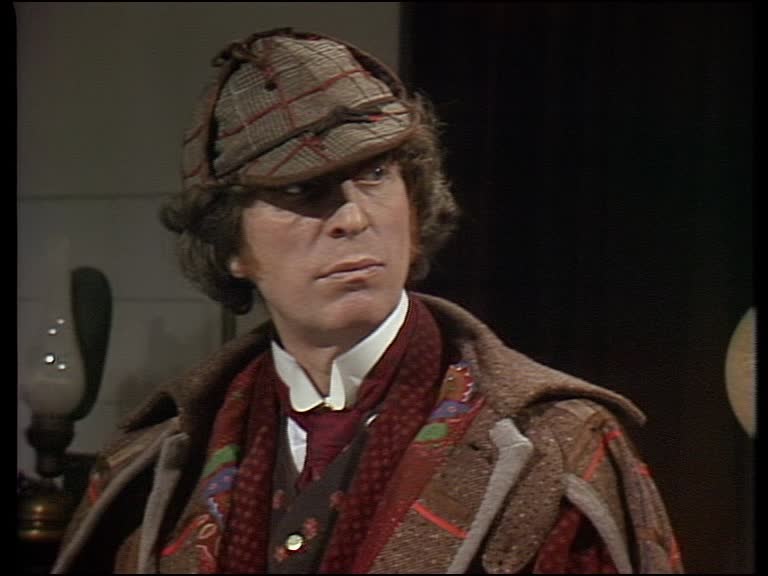
The Doctor at his inauguration. 
Wow. That was a hard six episodes to get through. ‘The Invasion of Time’ is the last story for Louise Jameson and frankly, it’s very disappointing. We have two main enemies – the Vardans for the first four parts, and then the Sontarans appear at the end of episode four and a rather non-sensical two parts are added to get the story to six episodes.
This is mostly the work of writer Anthony Read, who begins with a good premise – presenting the Doctor to have turned bad. He arrives on Gallifrey, demands to be inaugurated President (as he is President elect following ‘The Deadly
Vardan = silver foil.
Assassin’), then blows up a whole lot of things and lets some invaders in called the Vardens. That’s as far as the story holds up, by the time we’ve hit episode four there appears to be no story left, no budget left and no control left over the actors who have little asides left right and centre, make silly jokes and clearly do not take the thing seriously.
It’s reduced to such a farcical state that by episode six they are running around the TARDIS, mostly getting lost for the bulk of the episode – which over runs yet provides little plausible cause for Leela to have fallen in love with Andred and want to stay on Gallifrey. The Doctor has found the great key of Rassilon, but it seems the main purpose of that is to power a big gun.
The TARDIS workshop. Convincing? No.

Milton Johns as Kelner.
The Vardens start the descent into lunacy. Not only do they look like SS officers who weren’t told the secret handshake, they are appalling acted and in no way threatening at all. They were a poor concept to start with, and there is no logical reason why the Doctor would pretend to have gone over to the side of evil to trap them on Gallifrey considering how he had to punch a hole in the transduction barrier, which required him basically to be President to have that opportunity. There’s no real explanation with what they wanted to do with Gallifrey.


Then they are defeated with almost no climax, and the only thing that is dramatic in episode four is the
end when the Sontarans turn up. They use Chancellor Kelner, played by Milton John who does a great job as the slimiest Time Lord ever, to try and shut down the barrier to allow their entire fleet access to Gallifrey. This barrier is controlled from an old engine room somewhere which doesn’t fit with any of the sets, because it’s location work.


But so is the interior of the TARDIS in part four, filmed in a disused mental hospital. It just doesn’t match the console room or the rest of the story. The direction is woeful. The whole final episode is made up of running a bit, commenting that they are lost, making a gag and the next scene. Which is the same as that scene. AND IT OVERUNS. No material, no plot, AND IT OVER RUNS.
Then the Doctor is about to leave after defeating the Sontarans with a big laser gun, and Leela declares she’s staying. Very strange indeed. Total mess, easily the worst Tom Baker story thus far.

1.5/10

Monday, 2 September 2013

Underworld

CSO instead of sets.
‘Underworld’ I am told is regarded as something of a complete turkey in Doctor Who circles I believe. Well, do I concur? It’s fair to say that, in keeping with some of the earlier 15th season stories, it seems like this is a story which went into production before it was ready to. Firstly, the script needed another going over or two. There was some good ideas, the premise itself – a story based on the story of Jason and the Argonauts was a top idea from writers Bob Baker and Dave Martin, but after episode one it becomes a very confusing story which doesn’t fully explain itself.
The Doctor and Leela with the crew of the R1C.
Should a Doctor Who story explain every little thing? Probably not. But perhaps there were things that needed to be explained in this story and just weren’t. The slaves are mining rocks... I think, to provide energy for the Oracle. What is this Oracle? I think it’s the P7E, the spaceship that the Minyans are chasing as it has their race bank. If I understand the story correctly, it’s become basically a mad computer and a God to those serving it. Some of whom have evolved into robotic type servants.
It’s all there, but it hasn’t been well-developed. The characters in board the R1C are reasonably well defined, Jackson and his crew, although more could have been done with them, the slave
characters though are just caricatures with only two characters of note. Some of their acting is a little off what it needed to be to convince an audience as well, regrettably.
Then we come to the use of CSO, and the special effects. The design budget had very little in it, a lot was being held over for the final story of the season and they discovered they basically had no money to build the cave sets. Clearly they mustn’t have had enough to go down to Wookie Hole either where they shot ‘Revenge of the Cybermen’, which would have been perfect for this story. So they made a model and CSOed into the background for nearly 30 minutes of this story. Which over four episodes underran by ten minutes incidentally, which they could have used for story-extrapolation.
Only the bridge and the humans are real, rest is CSO,
This shot worked OK IMO.
Then again, the CSO took a lot of time to shoot and I suspect that a number of scenes had to be cut because they ran out of time to shoot them. Episode two is probably the worst episode. There’s a lot of walking around the caves, a long long LONG sequence involving gassing but generally it’s a very dull episode with a bit of over acting and a lot of walking about. The CSO to be honest, considering how hard it was to do, and the fact that cameras have to be locked off, is not too bad. It just doesn’t convince and perhaps it never could. K-9 moves merrily along rocks and dirt which you’d think would be hard for him, and hair and feet fade in and out. Then there’s that glow around most characters. The camera angles are
Just what the strange gold-headed guys are....
I'm not sure!
very static because the camera had to be locked most of the time to match with the CSOed background.
Good on them for giving it a go. They were considering abandoning the thing due to cost cutting, which may have pleased a few fans in retrospect. But robbed Who-history of four episodes.
As it stands it’s a story that doesn’t quite work, although I think episode one is in fact really strong. They chose a direction in Canadian Norman Stewart who understood the CSO technology well, but was a first time director and because of the technical issues couldn’t spend time on the actors and so forth.
I know it gets panned badly from Who-fandom, but I didn’t hate it, and I think it needs to be viewed with an understanding of the situation behind the production.

4/10

Saturday, 31 August 2013

The Sunmakers

Tom and Louise on the roof. Looks a bit Englandy to me!
Forgive me for being fooled, please. I thought for sure this would be a story about people making suns. It isn’t. What a great title let down by the fact that it’s misleading. Yes, the company running operations on Pluto did make six suns for the workers there, but that is not an important aspect to the story in any way.
A lot of action occurs in these awful corridors.
However, ‘The Sunmakers’ is a good story, let down by some shocking design decisions and an obvious lack of any budget whatsoever. I mean, half of the sets are no more than black drapes. Which I guess is fine if you’re a fan of the minimalistic movement, but when you combine them with corridors and a rooftop shot on film which don’t match, and most of the rest if the set painted orange and looking cartoonish – not to mention incomplete, it really detracts from the story in a pretty substantial way.
Which is a pity because Robert Holmes delivered a darned good script. A script about paying taxes (or not paying taxes), corporate greed and revolution. The characters are somewhat over the top and colourful, especially the Gatherer played wonderfully by Richard Leech, but I enjoyed that aspect. The workers are somewhat down-trodden, and the company pumps in gas to the Megropolis to keep everyone anxious and thoughts of revolution far from their minds. It’s not in all a situation that is impossible to imagine happening for real.
Leela in the correction centre.

The Doctor takes control.
The Doctor is at his best here. Tom Baker has all the shades of light and dark, humour and seriousness well at play during this story. Leela (Louise Jameson) gets a good deal to do on her own, and this was one aspect that made this Jameson’s favourite story. The rebels however, led by Mandrel  (William Simons) and supported by Goudry (played by Blake’s 7’s Michael Keating) were at times a little to West Side Story for me. Their genuine fear of Leela was a nice touch though. The collector though is the most interesting character, played by the rather short William Woolf. Stuck in his chair, the mannerisms
The wonderful William Woolf
In the rebels' lair.
are wonderful, considering the Collector was on morphed into a semi-human form, and was really a bacteria. Great idea, great performance.
K-9 gets a good run too, the white studio floors were good clearly for his drive units! Some of the corridor stuff was not so well directed, a but stunted and slow, angles that don’t quite work, shots that needed a fraction of a second or two shaved off to work properly. Still, it seems as if it was a very difficult story to put together.

6.5/10

Image of the Fendahl

The series rolls on with this episode, set mostly in a priory where some very stern scientists have found a skull which is far older than the human race and one of them is planning to unleash its powers so he can be a mighty ruler or something. It combines Medusa-like images with paganism, in a sort of mix and MASH of Pyramids of Mars with a slice of Masque of Mandragora and sadly comes nowhere near being as good as either.
The skull and Wanda Ventham.
It’s been quite a while since I used this word – convoluted. But it is the main problem with ‘Image of the Fandahl’ and is why I and I’m sure many other viewers of the tale are left scratching their heads. Chris Boucher is a talented sci-fi writer. This story was done as the hand-over to a new script editor was being done,  so perhaps it’s unfair to criticise it too much, but it doesn’t make a lot of sense, the characters of the Doctor and Leela don’t seem quite right, the other characters are simply not well used or well-written, and the pacing is very poor with three rather slow episodes followed by episode four where the Doctor explains a whole lot of stuff to try and make sense of what is going on and then blows up the priory as his solution.
Perhaps the script is under-developed. There’s definitely some great ideas there, but the narrative needed more work to it, to work on the pacing issues at the very least, flesh the ideas out so they made more sense. In episode three, probably the weakest of the serial, the Doctor and Leela go off looking for the Fendahl planet and find it locked in a time loop by the Time Lords but in no way does it advance the story, or make it more exciting. Episode three for the most part is treading water to get from part two to part four as far as I can see.
Denis Lil (left)
Denis Lil is the main guest actor, playing Doctor Fendahlman, who’s line of ancestry was destined to find the skull in which the Fendahl kept all its power. Why a human skull? Not really explained, although the Doctor hints that it may have effected human evolution, if not start it. Denis Lil is a fine actor, who did some great stuff in ‘Survivors’, but why he felt the need as the crazy scientist to add a crazy European accent I am unsure. Wanda Ventham, last seen in ‘The Faceless Ones’, comes back to Doctor Who as Thea who ends up being the main Fandahl of sorts when at the end of episode three she is painted gold and becomes a
Mother Tyler with Leela and Jack,
sort of Medusa – don’t look into her eyes. Why? No idea, it’s not explained. She does a good job but has little to do and no lines in episode four.
Daphne Heard is Mother Tyler, an older lady who is wise in the Olive Hawthorne guise a little (but older). It’s a nice, well-portrayed character as is her son Jack Tyler, played by Geoffrey Hinsiff. They both play important roles in the plot but the development of friendship with the Doctor and Leela, who only really meet one character, Ted Moss, in the first episode, is rushed and a little hard to believe.
George Spenton-Foster directed this one. His first Doctor Who, it suffers from the same issues of ‘The Invisible Enemy’ – it’s just not snappy
enough. The fourth episode, like the previous episode, is perhaps the worst in this case. There’s a scene in the cellar where the Doctor and Leela have to rescue Colby and everything is still, despite people dying and Fendahline being born. The scene lacks any sense of urgency at all. I think the music is not perfect for part four too, I love Dudley Simpson’s work but the use of slow organ music here helps to only slow the story down. Much of the dialogue has strange gaps between lines which don’t seem right.
A Fendahl
I would question also whether the Doctor should ever give someone a gun to shoot themselves – in episode four the Doctor assists in Stael’s suicide. I was taken aback by that. Also for some reason shots of fire at the old priory after the explosions are run backwards. The significance is not explained.
Finally, the Fendahl themselves don’t work very well, although the smaller ones are rather good. Too much time on screen is partly to blame, we never see them connected to the shots of their slimy tales too which kinda destroys the illusion, the design is ok but the whole thing needed to be slimy.
Wanda Ventham decked in gold atop a pentagram. 
It feels like a rushed job this one, with lots of issues that there wasn’t time to iron or work out. Robert Holmes is credited as script editor but in fact he was in the process of handing over to Anthony Read, which could explain some of the scripting issues. Nevertheless it’s a really hard story to get into.

5/10

Friday, 30 August 2013

The Invisible Enemy

Tom Baker and Frederich Jaeger
If only it WAS invisible! Surely this should be renamed ‘The Killer Prawn’ or something? It’s been a long time since we’ve had such a poor story, but Bob Baker and Dave Martin’s ‘The Invisible Enemy’ has some pretty shockingly-bad moments. As with any bad-who though, it’s far from being ALL bad. The ideas behind the story were interesting, but perhaps it was simply asking too much of the production team to deliver everything that was in the script.
Worse than the prawn, the enemy looked like
this inside the Doctor's head!
Let’s remember that Doctor Who was and IS made for kids first, despite its huge adult following, the idea of cloning the Doctor and Leela, shrinking them down to microscopic size and then having them walk around in the Doctor’s head is rather interesting. Of course, it was always going to be very hard to portray convincingly on television, especially in a story which already appeared to have a lot more sets than your normal Doctor Who story. Various rooms, corridors, the hatchery on Titan, the hospital on the asteroid, the Titan space craft and the inside of the TARDIS. PLUS all the different parts of the Doctor’s brain. It was bound to stretch the budget too far. And it did. Parts of the brain interior are fine, others are very tatty.
Inside the Doctor!
And what do you find at the centre of the Doctor’s brain, hiding away? A giant prawn. Words do not exist to describe perfectly how unconvincing this prawn was. This was the nucleus of the swarm, who run around controlling people’s minds saying ‘contact has been made’. Then some grey scaly stuff appears on everyone’s faces.

The swarm leader infects the Doctor, who becomes the key to it all, but he tries to resist. Leela is rejected because she is not smart enough! They land on Titan where they meet Lowe, holding out against the rest of the crew who have been infected. When he become infected he puts on a giant mask to conceal his face. As if anyone would  be fooled by that! Then he takes the Doctor away from Titan when ordered to protect the Doctor at all costs.
Instead he directs the Doctor, via TARDIS, to the hospital in the asteroid belt. The Doctor tells Leela the co-ordinates – she can suddenly operate the TARDIS it appears. Turns out this is the perfect place to determine the infection and find an antidote! Not good thinking by Lowe – played by Michael Sheard, now in his fourth Doctor Who story.
In his third Doctor Who story is Frederick Jaeger playing... you guessed it, another scientist! Professor Marius is a little quirky, with a slightly German accent (naturally) and a robot-dog assistant called K-9, who ends up going off with the Doctor. As the story progresses the Doctor ends up blowing
Leela and K-9
everything up on Titan where the swarm is about to hatch, ably supported by Leela and K-9, who work well together, although Leela does kind of feed K-9 the questions in dutiful companion-like manner.
The fourth episode in particularly feels like it was a struggle to make and act in. ‘The Invisible Enemy’ was directed by Derrick Goodwin, his first Doctor Who story and he seems to have struggled. The effects shots are a mixed bag for instance, some work well, others of the shuttle for example appear to be bouncing around on a string. Shots are held a little too long in places, and especially in the final episode pauses between lines or reaction is very stilted. When the Doctor dematerialises without Leela Leela watches, and waits a number of seconds to stand up and call out after the TARDIS has disappeared. Needed a more honest, faster response.
It's the giant prawn!
Design-wise they did the best they can, and I’m sure we can say the same for Derek Goodwin. I imagine it was a nightmare to direct, one of the most technically demanding. Some of the dialogue is poor and not in keeping with what Tom and Louise Jameson were used to I think. The prawn is sadly laughable and spends far to much time on screen. The script could have done with a bit of refining too.
5/10


Sunday, 25 August 2013

The Talons of Weng-Chiang

Tom Baker and Trevor Baxter

What can you say when you watch a story which fulfills all your hopes and expectations and leaves you thinking ‘wow’? Well, that’s my response to ‘The Talons of Weng Chiang’, written by Robert Holmes to fill a gap when Robert Stuart Banks was unable to complete work on a different story called ‘The Foe from the Future’. Incidentally, I had an adventure called ‘Future Foe’, I wonder if the ideas were the same. In my first incarnation I met Peter O’Feild, who already knew me, but I was meeting for the first time. If only I had known what a scoundrel and nasty pasty he was!
Chang and Mr Sin.
Victorian England was the perfect setting for a Doctor Who story, the Doctor often comes across as a Sherlock-Holmes type and with references to Jack the Ripper, a wonderful set of costumes to call on and one of the best and tightest Who directors in David Maloney, what could go wrong? Well, only the giant rat which did indeed look too cuddly, as producer Phillip Hinchcliffe remarked on the DVD. But we can forgive them that, otherwise it is a seamless piece of vibrant, exciting, at times dark, at times funny, television.
Before singing its praises any more though, one piece of conjecture marks this story, the casting of John Bennet as Li’sen Chang, a Chinese performer  of magic and key to the story. The make-up was very well done to make him look Chinese, but today you simply couldn’t get away with casting a white man in a different part. I’d like to say it’s all a part of acting, but is it? I mean an actor is ACTING, stretching their range to play a different race or culture, is it wrong? I can see arguments on both sides, and Doctor Who is littered with examples – Kevin Stoney in ‘The Dalek’s Masterplan’, Various characters in ‘The Crusade’, Patrick Troughton as Mexican Salamander in ‘The Enemy of the World’. All had a bit of cosmetics to make them look different.
The Doctor, Jago and Leela in Weng Chiang's lair.

Around the time of this series, ‘Gangsters’, a progressive and different series penned by Philip Martin, was also going to air in the UK. It featured a swagger of Indian and Asian actors who struggled with the parts they had save a couple of standout performances. They were the basis of the series, they had been searched for. David Maloney needed actors for six episodes at short notice, and at the time it could be argued that there simply wasn’t the depth of non-white actors that there is today in the UK. Nevertheless it’s not a great look for the programme, despite John Bennet giving a great performance.
Christopher Benjamin and Trevor Baxter
John Bennet in the Opium den as Chang
Along with the Doctor and Leela – and in no story has the Eliza Doolittle/Professor Higgins relationship been stronger and more apparent – Christopher Benjamin and Trevor Baxter step into the fray as Jago and Litefoot. The former runs a theatre, the other is a pathologist. Both are somewhat timeless characters, with their own range of Audio Adventures out there produced by Big Finish. A wonderful double act, and both great characters in their own right. Michael Spice, who provided the voice of Morbius, dons a mask and prosthestiques to portray the mastermind behind it all, Weng Chiang – properly known as Magnus Greel. The use of Deep Roy as Mr Sin, a creature from the far future created from the cerebral cortex of a pig, is also chilling and well done.
Shot in part in a theatre, in part at night of the streets of London, and of course in the studio, this story moves well, with parts five and six a little separate from the first four. Lovely touches of the period throughout, costuming is excellent, it’s a thing of beauty really. Interactions between Litefoot and Leela also very very amusing at times as she ducks into a roast with her hands! All in all, about as good as it gets.

10/10

Saturday, 24 August 2013

Robots of Death

It's the robots in control!
Not since Ian Stuart Black’s ‘The Savages’ was followed by Ian Stuart Black’s ‘The War Machines’, I THINK I am right on saying, has a writer delivered back-to-back stories in a season. Chris Boucher though does here, with ‘Robots of Death’ closely following on from ‘Face of Evil’. It’s a character-based whodunit in space, and a great murder-mystery it turns out to be. This might also be the first all-out murder-mystery style story that Doctor Who has done.

The Doctor and Leela look out the sandminder
And it’s pretty creepy, clever and for the most part well designed. The Sandminer is not a space ship perse, but it is a futuristic machine for mining planets, and it is where the entirety of the story, bar a TARDIS scene at the start, is set. Inside it is decked out in Art Dec o designs, and looks like a luxury liner of some description. It’s a great idea, considering a sleek space ship is hard to do on a budget and they really stretched this budget well.
On top of the murder-mystery elements, the other influence is Asimov’s ‘I, Robot’, with some of the directives being used, in  particular that robots can’t harm humans. Of course that also appeared in Tom Baker’s first story, ‘Robot’. Holmes and Hinchliffe spent the previous season using tried-and true horror stories to underpin the stories. Season 14 has seen them use other famous stories, some science fiction and others, like ‘The Manchurian Candidate’ for ‘The Deadly Assassin’, falling under a wider net of genres.
D84 sneaks up on Leela
At least they know they have a solid basis for the story, and here the story is about characters mostly. The robots themselves have a great ‘art-deco’  head, although the rest of the body is basically a costume and I’m not sure how believable that was. The idea was to make the robots look as human as possible. The humans on the sandminer are really living in the lap of luxury, hoping for the ‘big one’ – to find enough minerals to make them rich.

Superbly cast by Michael E. Briant, now one of my favourite ‘Who’ directors, the guest cast is led by Russel Hunter as Commander Uvanov. There are many sub-plots going on and he is at the centre
Uvanov and Toos in action.
of most of them, including the one involving Zilda’s (played by Gangster’s Tania Roberts) brother. It’s a classic case of someone looking guilty as hell, and then it turns out he had nothing to do with. The part works perfectly for that.

Dask goes a little crazy.
On top of Uvanov, David Collings returns to the Who-fold and Poul, a great performance as he has robophobia, and also some sort of agent. Interesting he is one of three human characters to survive the story. Yes it was another one with lots of death. Well, they were the robots of death! Pamela Salem plays Toos, the only other character to make it through, and the villain of the piece is Dask, played by David Bailie. It’s all a bit strange, his motivations, and the part isn’t very big – needed more exposition in my humble opinion. The rest of the cast are smaller characters, but strong characters and well played characters, the real strength of this story.
Leela (Louise Jameson) is showing a real aptitude for the space/time travelling, enthusiastic and willing to learn. Her character worked well again, and Tom Baker was solid as always. A good, solid, interesting story well told.

8/10

Friday, 23 August 2013

The Face of Evil

I know that face.... of evil!
On an unnamed planet, sometime in the future, the Doctor arrives. But – has he been there before? What did he do when he was there? His face is carved into a cliff-face Mount Rushmore style. It’s a great premise for a nice little story written by first-time Who writer, Chris Boucher, who wrote a lot of Blake’s 7 episodes.
Louise Jameson as Leela in her first story.
It’s very much an idea story, with a group of savages and a group of very arrogant technicians – ‘The Tesh’, who now worship the technology inside the space ship hidden by the cliff. The idea that the Doctor came along a long time ago and ‘fixed’ the computer – now calling himself a god, Xoanon, and that he got it wrong to turn the computer crazy is the strong basis for the story. Fans have to look past the fact that we don’t when it occurred, but as the face is Tom Baker’s, it’s supposed to have occurred before this story and after ‘Robot’. Strange then that the Doctor takes so long to actually remember what happened.
The Doctor helps the Sevateem.
It’s a little embarrassing seeing grown actors running around being savages. Not to the same point as in ‘An Unearthly Child’, but still the actors no doubt weren’t over the moon at the prospect of wearing so little. Louise Jameson is introduced as Leela, from the Sevateem (the savages) and as a choice it’s a brilliant way to go from producer Philip Hinchecliff. Leela is an original companion, and his idea that she would be like an Eliza Doolittle to the Doctor’s Professor Higgins was a masterstroke. Pure coincidence that Louise Jameson was a very attractive woman who most weeks will wear very little. Right....
But it’s great that there’s a logic and purpose to the relationship with the companion and the Doctor. The rest of the cast is pretty solid too, David Garfield was the standout for me as Neeva, a sort of priest/witch doctor who has his faith in Xoanon destroyed through the course of the story.  Pennant Roberts did a great job of directing this with a lot asked of the director. Visually it’s a good story, a good use of filming for the jungle – different from Zeta-Minor in the previous season, but shot and realised in a similar way. The only issue I have was the use of cycloramas as the sky, with different lighting used to denote day and night. It may have been all that was possible, but when a good portion of sky appears in a shot, the illusion is somewhat shattered.
The Tesh.
The soundscape in the first episode though with the use of film and the eerie jungle is VERY other-worldly, and well done. However, the strength of this story is its ideas. It is what I would call an ideas story – the Doctor arrives and has to figure what’s happened. Not only in his own past, but where have the Tesh and the Sevateem comes from? (They are descendents of the ship which houses Xoanon. Tesh were the technicians as mentioned, the Sevateem were the survey team). Once that is unravelled the Doctor is left with the task to remove his print from Xoanon, who is a very confused computer – confused about his own identity. Computer stories have become very popular it seems by this time, the unique part was the Doctor’s influence on this one.
The Doctor savaged by Xoanon.
And so there you have it. New companion rushes into the TARDIS at the very end with no invitation. In fact, the Doctor appears to want to travel alone. But that decision is out of his hands – as it was out of Tom Baker’s hands at the time. Apparently he didn’t want a companion, he wanted to talk a lot to himself. Curious directorial choice to have him do just that when he arrives in episode one, and to direct some of the dialogue down the camera. A nice little story.

7/10