Thursday, 18 July 2013

The Three Doctors

Have you ever met yourself? I have. It’s a very frustrating experience to be honest. At least in this story the three Doctors didn’t start singing and dancing – that’s what happened when I bumped into to other selves the last time.
Publicity shot of the Three Doctors.
Please see ‘The Quest for the Golden Slippers’ for more information.

‘The Three Doctors’ was penned by Bob Baker and Dave Martin, and in some ways is the least bizarre of their first three tales. An honour to receive the chance to write the first ever multi-Doctor story I expect, they acquitted themselves very well. But as a viewer, it’s just a joy to see, above everything else, Jon Pertwee and Patrick Troughton on screen together. They look like they actually get along very well, but I believe initially they didn’t. However their dialogue, their exchanges were just a joy to behold, and Baker and Martin wrote very well from Troughton.
Poor William Hartnell, in poor health at the time, gets sadly very little to do except appear on the TARDIS scanner and issue instructions. Would have loved even one scene with him and the other two in the final episode. It’s a pity that wasn’t possible and for much of the story it is sadly just the two Doctors.

Perhaps though the actor that steals the show in this one is Nicholas Courtney as the Brigadier in the way he deals with Patrick Troughton, not to mention the situation. Finally the Brig and Benton (John Levene) get inside the TARDIS to see what it’s all about. Nicholas Courtney spends most of the four episodes disbelieving everything the Doctors say to him, blowing his top and being extremely army-like (as in more than usual!). As with Jon Pertwee his best stuff is playing straight man to Patrick Troughton.
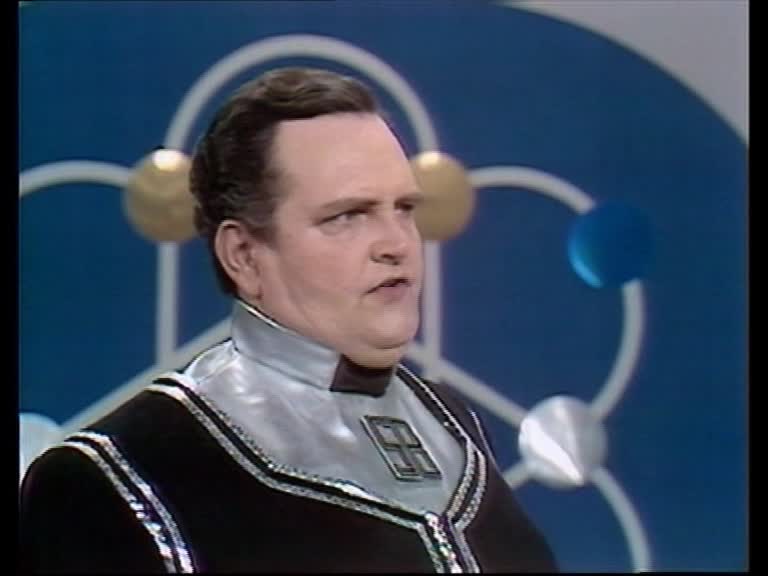
We have the return of the Time Lord home planet, still unnamed (Spoiler alert: It’s Gallifrey. I should know, I was born there!). It’s very big and very blue, and we have a bunch of Time Lords without names who we don’t know much about running the show.
Then there is the villain of the piece, Omega, played by the boisterous Stephen Thorne. Thorne was equally as loud as Azal in ‘The Daemons’, still he didn’t hold back here either. In an interview on the DVD he said he would have played it much softer if he had the chance to do it again. He did, perhaps push it too far, although I didn’t mind the performance to be fair. It certainly is a very impressive voice! The mask and look was rather good too.
Omega
The story is not as clever as the previous two by this industrious writing pair. ‘The Mutants’ especially makes the audience think and analyse, and ‘The Claws of Axos’ is full of ideas an imagery, however, ‘The Three Doctors’ is an anniversary tale, and as such is somewhat functionary to allow the Doctors to come together. The ideas of anti-matter and going through a black hole are nevertheless interesting and may well have perked some kids’ interest in science and astronomy.

Back in a quarry, it would have been nice for a different sort of world, as much as did suit the world of Omega for the story. Quarries, by now, have become almost the default exterior location for filming Doctor Who. The sets were colourful, the use of bubbles nice on the walls, although the ‘blob’ or ‘bubble’ creatures were a little too comical for my liking.
The Brig and the second Doctor have some great moments.
Even counting the negatives, Patrick Troughton on screen, in colour bickering with Jon Pertwee erases most ills of this story in my opinion, and makes it an enormously fun!

8/10

Wednesday, 17 July 2013

The Time Monster

The Doctor prepares to track the Master.
‘The Time Monster’ was an interesting story. A lot of fun, a bit crazy and definitely non-sensical,  but an interesting idea that may or may not have worked. I’m still not sure. On the one hand as an audience member I had to suspend disbelief when looking at a man in a white bird suit apparently being the monster, and groaning at the name ‘Chronivore – eater of time’, and yet for much of it I enjoyed the absurdity.
Barry Letts the Producer often said he wanted science rooted in fact. Let’s be honest there was little to none of that in ‘The Time Monster’, which he co-penned with Robert Sloman who was credited with this story. I think it’s great that
Man in a white suit = monster???
Doctor Who had a story which had a little to do with time – such as the season opener in ‘Day of the Daleks’, but not a lot was made of it over these six episodes save for some things being brought forward in time to attack UNIT troops and the like. The plot again reads as the Master trying to control a being he could ultimately have no chance of controlling to give him the ultimate in power – which admittedly changes from story to story. Here it’s presumably power of all of time. He also tried to harness the Nestene, the doomsday weapon, the power of Azal and so forth.

The TARDIS full of salad bowls!
That aside, if you allow yourself into the world of this story it’s quite light-hearted despite the destruction of Atlantis and a couple of deaths. It moves at a decent pace, with the last two episodes set in Atlantis and features a lot of the TARDIS – both the Doctor’s and the Master’s, which we've seen precious little of since Doctor Who went into colour. Apparently no-one likes the salad bowl sets, except for me. I think they looked smashing and might yet decorate my TARDIS in such a design.
Delgado and George Cormack.
Moving on the cast is superb. Roger Delgado holds nothing back in this quintessential performance, whilst Jon Pertwee, Nicholas Courtney, John Levene and Katy Manning are clearly having a ball. The Doctor builds a device to interfere with the Master’s TARDIS out of forks, a wine bottle and tea leaves, whilst the Master drops a doodle-bug on Mike Yates. Benton outwits the Master ever so cunningly only to have the Master fool him even more simply. THEN Benton ends up a baby!
Ingrid Pitt.

Ingrid Pitt guest stars as Galeia, Queen of Atlantis, a city with a lot of topless men who are very very white. The guest cast is full of brilliant performances from George Cormack as Dalios to Wanda Moore as Doctor Ruth Ingram. We even have another character in the style of a useless bureaucrat in Doctor Percival, played by John Wyse.
A wonderful array of sets for Atlantis, essentially only appearing in the final two episodes, were contructed too and kudos to the team for that because they can’t have had much money for them. Unless they borrowed them from ‘I, Claudius’ ???
Look, it’s no classic, some could even say it’s so bad it’s good, but I think it’s a pretty enjoyable 6 part story.

7/10

Sunday, 14 July 2013

The Mutants

Another great, inventive, clever, ground-breaking story. It was written by Bob Baker and Dave Martin, although at times feels like a Malcolm Hulke story with political overtones pertaining to the British Empire and its downfall.  Add to this the idea of a species mutating to adapt to its environment, the use of humans basically as the bad guys, the message of ‘just because it looks horrible to you doesn’t mean it is horrible’, I think ‘The Mutants’ should be up there with the classics of Doctor Who.


It moves very well for a six part story, adding new elements and characters as it goes along with various storylines intertwined; narratively it is very well done. The director, Christopher Barry may have wished he hadn’t had such a bizarre and challenging piece, but I think he makes a decent fist of it. The use of lighting and colours in the caves is great, and I felt that the majority of the CSO shots worked effectively.
Paul Whitsun-Jones
The casting has a question mark over it in fan circles. I have heard that Rick James, an actor of African descent, is regarded as one of the worst actors ever in the history of the show. I can’t really agree, although some of the lines are clearly written for a cockney accent, as the writers had originally planned for the character of Cotton (you’d have thunk the director might has also changed the character name). It’s at the very least refreshing to see an African character in a main part in Doctor Who, indeed in any early-1970s British show. His delivery is stilted throughout, but I’m not sure it is ‘bad’.
Jon Pertwee with Varran and Ky (right)
Paul Whitsun-Jones as the Marshal is perhaps just a little too stereo-typically megalomaniac for me, and is thus my biggest beef with the story. In his second Doctor Who story, he is very one-dimensional which is a pity. The part was presumably also written in such a way, but a different actor may have brought something less predictable to it. Other casting was spot-on with Geoffery Palmer again failing to last long in his second Doctor Who story, and James Mellor and Garrick Hagon perfectly cast as Varran and Ky respectively.
The ‘mutt’ costumes also deserve a mention. Very well made and effective, much better than the Silurian or Sea Devil costumes. Dirty and horrible
In the lab.
yet beautiful in a strange way at the same time. The design and set work is great, even if Skybase is quite over-lit (not a major surprise there). Jaeger’s laboratory is very functional in its design, and apparently the wall decoration used has been replicated many times since. Uniforms for the humans were a little predictable perhaps, but no ridiculous which has often been the case. The model work is mostly excellent, with the exception of the Investigator’s ship where it seems they just ran out of cash. Skybase itself looks great from outside. Some of the best model work to date along with ‘Ambassadors of Death’.
End of Episode Four.
The end of episode four (I think) sees Skybase punctured in a crazy scene with Varran flying out through a huge hole in the side of the space station. This was just one of the many technically difficult scenes Barry had to shoot, and whilst the first part of it works very well, it lingers on Jo, Stubbs, Cotton and the Marshall hanging on from grim life except they don’t appear to be and it’s poorly directed and acted.
Barry had to deal with psychedelic caves, transforming one of the leads into a super-being, making the planet misty (presumably with mist-machines!), lighting and shooting in caves, a large amount of CSO and who knows what else. I reckon he did well.
Ky trasnformed.
For me, the production has a few problems, a few moments that weren’t presented as well as they might have been, however, the storyline is brilliant, and more than makes up for the bits that are rough around the edges. It was one of the most daring, different and difficult stories the production had encountered at the time, rivalling ‘The Claws of Axos’. Loved it.


9/10

Friday, 12 July 2013

The Sea Devils

Malcolm Hulke’s ‘The Sea Devils’ capitalised on the success of his season 7 story, ‘The Silurians’. It also capitalised on the location chosen with a castle, a fort, a navy base and several navy vessels a real feature of this six-part adventure, the only Pertwee story so far set on Earth but without UNIT.
He's back! And he's an Admiral?
We do, however, see the return of the Master. Inevitable, yes, predictable – even more so. I’m surprised after five stories in a row with him, Barry Letts didn’t hold off a little longer before bringing him back. It’s a pretty good story for Roger Delgado too. On top of that the story has two government officials of dubious moral character to infuriate the Doctor – such characters have become the staple of the Pertwee-era as far as I can see.


Trenchard and Captain Hart.

We have Trenchard, the prison-warden in charge of looking after the Master but ever so easily manipulated by him, and Walker from the ministry, who keeps ordering food and wanting to blow things up. Trenchard ends up dead when he realises the folly of his way, and it is a sad death in the end at the hands of the sea-devils.
The Master comes to the aid of the Sea Devils.
The monsters of this piece, the ‘Sea-Devils’, are a more successful form than the Silurians, if still far from being perfect. Their eyes don’t move at all which always results in the destruction of belief on behalf of the audience, the actors inside the suits had their heads in the necks of the costumes so the heads wobble but not in a believable way, but the skin is pretty well done and if you don’t look too hard you could be convinced. Maybe.
More to the point only one can speak, and the voice is better than that of the Silurians, and we are spared the dreadful dialogue those particular ancient reptiles had forced upon them. A definite plus. It’s great to see a story with so much shot on film too. Minor quibbles are the end of episode four (I think) when the Doctor disappears in the diving vessel. Jo pokes her head inside and the Doctor is gone, but it’s not very clear. Then at the start of episode five she reinforces the point with ‘he’s gone’. I really hate it when they spell things out like that!
A great story for Jon Pertwee.
The combination of stock footage coupled with filming on actual navy vessels gives it a really authentic feel. Hulke writes a bunch of different characters – two men on the sea fort and the men in the submarine in particular – which don’t see a lot of action but are both well written and well played.
Pertwee clamours through passageways.
There’s some wonderful humour injected at times which Jon Pertwee plays superbly – especially when a radio blows up in his hand. He has a particularly good story, finding himself in diving suits, boats and being very much the action hero. The navy were happy to join in as extras and provide all the vessels etc. Pertwee himself had a military history and had starred for many years on the radio drama ‘The Navy Lark’.
Sets are very good, especially the castle and navy base ones. The Sea-Devils’ base suggests that they had run out of cash, mostly just black walls, but effective in its own way. Definitely preferable to white or light walls. The final episode seems an ‘almost’ pre-emptive nuclear strike, the Master fake his own death, boat chases and the Doctor blow up the Sea-Devil base. He turned on them a bit quickly for mine, to be fair, to resort to that when he was so upset by the Brigadier taking the same action in ‘The Silurians’. The Master also is very trusting of the Doctor considering their history. But minor quibbles.
Episode Six is action-packed indeed as I have mentioned, it needed another five minutes as it ends very abruptly. The story keeps good pace for a six-parter throughout. A great Doctor Who tale.

8/10

Monday, 8 July 2013

The Curse of Peladon

Following the season opener, the Doctor and Jo have been released from Earth for a second time to help out the planet Peladon, seeking entrance to the Galactic Federation sometime in the future. It’s an interesting blend of the new and the old – Peldadon is a planet seemingly in its own ‘middle ages’, ruled by a singular castle in a cliff where storms rage and beasts roam.
Izlyr, the Ice Warrior, with Alpha Centauri, the Doctor and Jo
The thing is, we are presented with merely a glimpse of the planet, and another planet that presents as a small city at best. It’s a great image to start with, but quite limited in the end. However, ‘The Curse of Peladon’ is a pretty good tale.
King Peldaon fails to win Jo's heart :(
For starters, we have David Troughton, son of the second Doctor (who also appeared in the War Games’ appearing as King Peladon in a great performance. We have the return of the Ice Warriors, whom the view spends most of the time presuming to be the villains, but as it turns out are not! It’s excellent that Brian Hayles, the writer and creator of the Ice Warriors, saw fit to present them in a different light rather than the atypical ‘they are monsters, therefore they are bad’ approach.
I like the imagery, the direction, the story. The costuming is excellent, the only thing missing is the concept of Peladon as a world, rather than a small kingdom. How does King Peladon rule the world? Especially without even basic wifi!
The Galactic Federation have sent delegates from four planets, including Earth (who doesn’t show up until the very end, and the Doctor poses in their place), Mars (the Ice Warriors), Alpha Centauri and Arturis. The last two are both rather clever creations. Alpha Centauri has multiple legs and one giant eye, and perhaps looks a little ridiculous by 2013 standards, but I rather liked. Arturis was very nicely made, a small green creature in a machine that kept him alive and allowed him to be mobile.
The strange and devious Arcturus
There is a great action/fight sequence between the Doctor and Grun, the King’s Champion, in a sort of pit they are lowered into surrounded by ropes. It was rather well done, and well thought of artistically. Then we have Aggedor, the ancient beast of Peladon, whom the High Priest Hepesh (getting to this character) has made a sort of god. This was very well shot, as was the whole piece, so that they never had him on screen for a long continuous period of time which would have emphasised the limited ability the production crew had to make a convincing looking beast.
Aggedor was mostly shot in the shadows, and thanks to good lighting, there were plenty of those. Doctor Who sometimes has over-lit sets which makes them look really bland, but in the Pertwee era usually the lighting has been much more subtly done thus far. ‘The Curse of Peladon’ is another example of that.
As for Hepesh, the high Priest of Peladon played by Geoffrey Toome, and the guy responsible in the most part for all killings and so forth, it’s a very considered performance in a role that despite his actions, the audience can sympathise with. In some ways the story is a bit of a ‘whodunnit’ especially in the first couple of episodes. It’s great that it’s not a black and white case of ‘he’s a bad man’. That coupled with the Ice Warriors who even defend the Doctor at times, makes this a well thought-out story. To be fair to the Ice Warriors, only in ‘The Seeds of Death’ have they been involved as full-on baddies who just want to invade and kill. In ‘The Ice Warriors’ they are trapped in the ice and desperate.
The Doctor fights Grun in the pit.
And so ‘The Curse of Peladon’ has been reviewed. Mostly positive stuff, without it being brilliant or extremely exciting. My only other criticism would be it is a little slow, but an enjoyable tale with some wonderful memorable moments such as the fight in the pit, oh and perhaps the best of all is Jon Pertwee singing a Venusian lullaby to calm and slightly hypnotise Aggedor. A wonderful moment for the third Doctor there.

8/10

Thursday, 4 July 2013

Day of the Daleks

Style's house, the Doctor arrives!
Guerillas hold the Doctor hostage.
The Daleks are back to kick off the ninth season after a long absence! I watched the special edition for this one, and I thought it was pretty awesome, although I hear the Daleks sound funny in the original version? Nevertheless it’s a very intelligent, clever script by Louis Marks, writing his first story since ‘Planet of Giants’. It’s fair to say the two stories are not similar in any way! Which is a good thing for this tale!
We’ve seen space and time played with a little since Jon Pertwee started as the Doctor, most notably in ‘Inferno’ with the idea of an alternative reality. ‘Day of the Daleks’, originally written without the Daleks, explores the ideas of trying to change the past to change the future, and the circular logic which locks you in when you try.
Guerrillas from the future come back to murder a man they believe started World War Three by blowing up a house with a host of delegates inside. Turns out it was the guerrillas that blew it up in the first place! Oh the irony!  But it’s also the real strength of this story, it’s use of time and the inability for people to see what was their own fault.
Aubrey Woods
The script isn’t perfect. The Daleks have invaded earth (in the 22nd century) to exploit it for its minerals – seems a bit dubious and low-key for the Daleks. The previous time they invaded the Earth they wanted to take out the core and use the planet as a giant space ship.
There’s a good balance of film shooting and studio stuff. However the Doctor’s laboratory, where again we have the TARDIS console outside of the TARDIS, has a door way that leads out to a passageway which is just bright yellow! I’m not sure why, the Doctor and Jo had to be inlayed in the doorway which explains it production-wise but not within the world of the story.
The chief guest star of the story was Aubrey Woods, who sang the ‘Candy man’ song in Willy Wonka and the Chocolate Factory all those years ago and has a certain eeriness about him – and also is a little like Liberace. The performance given as the Controller seems to be one of conjecture – it is very theatrical in nature and certainly not naturalistic. In some way it just adds to the weirdness of the future Earth.
Again Sergeant Benton has a case of the unbelievable happening before his eyes, when a guerrilla disappears before him in the ambulance. In ‘The Mind if Evil’ especially he  has a series of things go wrong when he loses Captain Chin (after she knocks him out), in ‘The Daemons’ he steps into a force field which lashes him about. Interestingly, there is a rare example of Captain Mike Yates (Richard Franklin) pulling rank on Benton, when he tells him to do his round and then nicks the cheese and biscuits.
Strange scene with yellow corridor.
Jon Pertwee’s Doctor  is not the anti-authoritarian figure we have seen in stories such as ‘The Silurians’ and ‘The Claws of Axos’, in this one. Instead he is impressed by Sir Reginald Style’s wine collection and sticks up for Styles when the guerrilla’s accuse him. Styles is very much an establishment figure of British Government and the person the guerrilla’s have returned to kill. Interestingly also, the exact date isn’t given in this story – nor in any other Pertwee story. Of the day and the month is, but not the year, so as to keep it ambiguous exactly when the Pertwee adventures are taking place. The brief was, apparently, the near future.
I understand the biggest change bar Dalek voices for the Special Edition is the Dalek battle at the end, which
Daleks and Ogrons, their helpers, approach the house.
has been beefed up considerably from the original which only featured 3 Daleks – all they had at the time! So that was done rather well. All in all, ‘Day of the Daleks’ is a cracking good story though. Does it need the Daleks? Hmmm I would probably say it doesn't, but they certainly don’t detract from the story in any way.

9/10


Wednesday, 3 July 2013

The Daemons

Burn him, he's a witch!
I know in principle I shouldn't like ‘The Daemons’. Quite frankly the whole story is pure nonsense with a scientific explanation thrown in to try and make it all palatable. The fact is though, I loved ‘The Daemons’, a story drawing on witchcraft, sorcery and the devil to entertain its audience. And entertain it did. This is the first, and I believe only, deliberate five part Doctor Who story. The two Troughton stories were altered to make five parts as one was too slow. It’s interesting that they never did a lot of five part stories. With 25 episodes in the first two Jon Pertwee seasons, it seems the logical thing to do, and four parters sometimes end a bit abruptly and six parters often drag out too long.
Is this romance for Benton and Miss Hawthorne?
Anyways, to this story with a wonderful amount of location filming in the town doubling for ‘Devil’s End’. It really adds to the feel of this story. The colour restoration on ‘The Daemons’ is excellent as well, the best of any story I’d have to say. The Master changes his name to Mr Magister and becomes the resident Vicar of Devil’s End, so that he can start a sort of demon worship to bring forth an ancient demon – really an alien naturally with super-powers, in the hope that the demon will let the Master rule Earth.
I the Master am in command of the CSO!
See – it’s very flimsy at best! There are ceremonies and robes and a bit of over acting here and there, and yet ‘The Daemons’ turned out to be one of the most enjoyable stories of all. It has a wonderful ‘family’ feel – the UNIT family. Jon Pertwee as the Doctor backed by Nicholas Courtney, Richard Franklin, Katy Manning and John Levene, again pitted against Roger Delgado’s Master. And essentially they are the principles of the story, with Stephen Thorne chiming in as Azal the demon and a very notable guest appearance by Damaris Hayman  as Miss Hawthorne, a crystal-ball wielding white witch!
Nothing says 'fun' like morris dancing!
They all clearly enjoy working together, and bring life to a story that done badly could be very bad indeed. Production-wise there are a few rough edges, mostly concerning CSO and the not-as-
Breaker Breaker where's the Brig when you need him???
tight-as-they-should-be tights of Azal and Bok, the gargoyle who comes to life. But those things are easily over looked. It has a wonderful dark-feel mixed with comedy and comradery. The Doctor’s car Bessie is almost a character in itself, and the town’s folk, although not playing a huge roll, are suitably eccentric and amusing to capture the feel of a town like Devil’s End.
All in all, it’s one of the most enjoyable Doctor Who stories I have watched thus far.

9/10