Showing posts with label Sophie Aldred. Show all posts

Thursday, 24 October 2013

Survival


The final story in the show’s first 26 years, before a break of seven years, is quite a good one written by Rona Munroe, one of a select group of women to have ever written for Doctor Who. When you look back through the first 26 years to find a female writer for Doctor Who is not easy. There’s Jane Baker, part of the husband and wife team, Barbara Clegg, there aren’t many others which is really disappointing. It could ask the question – is Doctor Who a male-only domain. Verity Lambert was the first producer, but again the only female in that role too. It is definitely disappointing.
Hale and Pace guest star,
Nevertheless, here’s a writer that created a story somewhat simpler than the other three in season 26, and that certainly didn’t harm the story. But it’s not that it’s not complex, just compared to ‘The Curse of Fenric’ it unravels in a far more straight forward way. Add the use of great music (Dominic Glynn) and special effects, great dialogue, the show finishes at least on a high.
It features the return of Anthony Ainley to the series as the Master, a more base and desperate Master, which worked rather well. He was certainly less camp than in the past which was obviously a good thing.
The Master's new look.
The use of modern (at the time obviously) Perivale as a location was great too. It’s very rare Doctor Who goes into domestic lives, if ever, but it did here. We go back and forth from the planet of the Cheetah people to Perivale.

I liked and was intrigued by the idea that the cheetah people were connected to their planet. I wanted to learn a bit more about that relationship and how it came about. The idea that the fighting would destroy the world, whilst literal in the sense of the storyline I think was also meant metaphorically to the human race (and I guess also a little literally as well, fighting will destroy the Earth).
Near the end we have a huge explosion on top of a hill as a supposed result of two bikes crashing into each other (when of course that never happened) and that looks great from the effects team. The cheetah-people costumes have copped a fair bit of criticism though from fans. I can see why in some respects, the heads, although the mouths move rather well, are bulky and fluffy and the actors couldn’t move smoothly in them like real cheetahs. To be honest I didn’t mind them and had a hard time picturing what else they could have done. I guess they expected them to be more human and less cheetah, but that would have aroused criticism as well I suspect.
26 years of Doctor Who, And I have got through it all since February! The only ‘cheat’ in all that time was watching the condensed versions of Marco Polo and Galaxy Four, although Galaxy Four was much closer to full length. Since then I have also seen Enemy of the World and Web of Fear, returned to the BBC recently in their entirety. It’s been a great ride, BUT it is not yet over. I think by the end of the year I can cover ever televised adventure, so it’s on to the TV movie next, and then the new series.

To see it all as a whole is interesting, in the order intended. In some ways the
final season of the show was really starting to produce some interesting television, however the stories were very complicated and I suspect the casual audience may at times have felt alienated and unable to follow. The show had its ups and downs through the years, but was strongest and most stable through the Pertwee and Tom Baker years. But most fans would say as much. The John Nathan-Turner Years, from season 18 through 26, had great highs and lows. Most seasons, save season 24, had at least one really
good story, but always there was dud or two where the production team dropped the ball. Now things change, budgets increase, and for a one-off movie, we head to America…

8.5/10
The Doctor and Ace walk off for the final time...

Wednesday, 23 October 2013

The Curse of Fenric

Dinsdale Landen as Doctor Judson.
A veritable giant as far as classics go, ‘The Curse of Fenric’ has an awful lot going for it. Compelling characters, good use of Ace, wonderful performances, perfect location. However, I can’t help but think its status as ‘classic’ should be seriously questioned. Whilst I for one second would not say it isn’t a very good story, I can’t put it up with the best of the best for several reasons.
Tied into a bundle though, it, as always, comes down to the writing. There is a lot of good writing in here, but it felt like Ian Briggs was at times putting too much into script. We have vampires, Russians, evil Generals, a
Nicholas Parsons.
cripple who’s a genius, Various subplots, a curse affecting almost every character, Ace’s mum as a baby, and we have Fenric, who isn’t quite defined at any point (not an issue) but described as ‘evil’. The issue comes with how you destroy ‘evil’. Apparently, you gas it to death.
When the Doctor turns on Ace, I find it hard to believe Ace would not have seen it as an obvious ploy. It’s very obvious to the audience. In my opinion it needed time to build up over an episode or more until Ace just snaps, but it was a plot device and thus wasn’t worked through as well as it could have. The whole point of the chess game
Alfred Lynch as Millington.
too seemed chucked in there either to tie up loose ends or because the writer was looking for an ‘out’. The idea that the Doctor and Fenric were locked in a chess game, then Fenric was trapped in a flask, and the Ultima machine – a super computer, was needed to let him loose didn’t make sense to me at all. The resolution of the game, with black and white pawns fighting together, makes no sense either, it just seemed like an out. It clearly doesn’t happen in a chess game.
It’s a pity because the point where Sorin (Tomek Bork) is revealed as Fenric is wonderfully chilling. The story in its original form (and for once I watched the special version, which has a lot of material added to it) had a lot of stuff cut out. In fact every season 26 story did, and none are particularly easy to follow. Cartmel must shoulder the bulk of
the blame for that. It seems by this time telling a good solid story wasn’t high on the priority list for the script editor. This one is not really that complicated, but a lot of things don’t make an awful lot of sense.
Which is a pity because a bit more nutting down of the script basics would have helped enormously. I’m not sure the point of having vampires in the story was if they are not the focus of the story. It’s just a strange addition to the plot where Briggs’ decides he wants to explain what vampires REALLY are. They still could have used the ancient one, who was a pretty decent monsters. Most of the monsters were decent in this one, if not all.
Alfred Lynch and Dinsdale Landen as Commander Millington and Doctor Judson, two wonderfully twisted characters, certainly shine in this story. Millington comes across as not just twisted, but also sad at the same time. It’s actually a beautiful performance in many ways. Nicholas Parsons as Reverend Wainwright is the best example of stunt casting in Doctor Who’s first 26 years. A game show presenter, he also did have an acting background. It’s a wonderful heartfelt performance, coloured with true sorrow and fear. Sophie Aldred is very good except for the well-known seduction scene which I personally didn’t buy at all – she admits to being so cold at that point that acting was almost impossible and I really like Ace so that is forgiven. McCoy is ok except when he has long angry speeches to deliver which I’m really sorry to say still do not convince me.
The Ancient One.
Mark Ayres’ music is generally very good, but I don’t like the stuff he uses on action sequences. Apart from that he is a fantastic composer. Visually the story is almost perfect, but it is spoiled by being shot on OB video again. It was all shot on location, and if they could have seen their way to shooting the whole thing on film, the atmosphere would have been even more sinister and dark. At least the quality is sharper than ‘Ghostlight’ – more light helps, but also they still had the master tapes when making the DVD.
Unfortunately the skies were far too bright though, it really could have done with some storm clouds.
This again comes across as quite negative, I’m sorry because as I said, I think it’s pretty good but over rated. The plotline is very important to me and when I feel it’s doesn’t quite make sense or work, then it affects my viewing. Nevertheless, a great, solid story.

7/10

Ghostlight

The Doctor and Ace meet Redvers Fenn Cooper
Marc Platt had apparently been trying to get a gig as a Doctor Who writer for some time, and finally in the 26th season of the show, he got his chance with ‘Ghostlight’, after his initial submission proved unworkable (a story set on Gallifrey called ‘Lungbarrow’).
‘Ghostlight’ is a very different story again from the rest of the season, the rest of the McCoy era, and indeed Doctor Who in general. In my opinion, this is clearly the best Sylvester McCoy story of all, with only two issues. One – Sylvester McCoy is generally excellent through
John Nettleton as the Reverend Ernest Matthews.

Katherine Schlelsinger as Gwendoline
the three episodes, however in the final episode there’s a moment where he tells Light to leave Earth, and to be frank I’m not sure what he’s doing. Whenever he has to act really angry he screws up his face, holds out a hand and loses the audience. It’s a bizarre step out of the world he is in to what appears to be some desperate acting. Alan Wareing should have been on to that and reshot it at the very least, but it remains in there for all to see. It’s not the only time he’s done something like that, but this stands out because generally the rest of the story is McCoy at his best, playing games with Ace and being mysterious.
My second issue is with the picture quality. There wasn’t much that could be done when making the DVD, sadly most of the original video tapes with original footage were wiped so they couldn’t remaster them particularly. They had to work off the finished product which does look like it’s down a generation or two. Remembering that in the days before digital TV to edit video you basically had to copy it and lose a generation. With ‘Ghostlight’ being such a low-lit story, the issues are compounded and there is a lot of grain for something not shot on film. Such is life, it doesn’t detract too much from the story.
Sophie Aldred as Ace
The story is about a survey team sent to Earth to catalogue life. We have the control subject – ‘Control’(Sharon Duce), and the survey – Josiah Samuel Smith (Ian Hogg). In charge of the survey we have ‘Light’. The idea is that Control stays the same, whilst Josiah evolves with the planet. Light is fed up with the constant evolution and decides to destroy Earth, but instead the ship is taken away from Earth and continues its search for life with Control and Redvers Fenn Cooper (Michael Cochrane) at the helm.
Ian Hogg (Josiah) mencaces Ace held back by Sylvia Syms
The plot is all there, but there was a lot of scenes cut for timing reasons which may have helped the plot to be clearer. Andrew Cartmel laughs at people who were confused on the DVD, but although I understand the thing, it is the sort of story which requires the audience to piece it all together to comprehend what is going on. For a young audience that would be hard. I think watching this story in one sitting is advisable too, allowing the viewer to connect threads throughout the three parts rather than desperately trying to remember things from the previous week (presuming they watched an episode a week as it was originally broadcast).
Having said that, there’s nothing wrong with a plot which requires effort from its audience at all. The music, although a little loud at times, is excellent, the house is very well done and the vision presented by the director is amazing. Wareing has really brought to life a Victorian house in Perivale, made it creepy and sinister, and his casting was impeccable. From John Hallam as Light down to Brenda Kempner as Mrs Grose, every character was played by the perfect person for the part.
John Hallam as Light
Being contained entirely within a house probably helped curtail the budget, but it meant that every little detail could be gotten right, and they did. This is a wonderful example of a story that unfolds, that peels itself piece by piece, to reveal a clever if somewhat confronting at times plot. We have the struggle between theories of life – religion versus evolution, although the story certainly is on the side of the evolutionist. Set in Victorian times, this was a hot issue on the tails of Darwin’s theories.

This story has no Daleks or Cybermen, no epic battles and no alien worlds. And it is the better for it. It shows that a strong cast, a strong director and a cracking script is all that is needed to produce a brilliant piece of Doctor Who.

9.5/10

Monday, 21 October 2013

Battlefield

Nic Courtney and Jean Marsh.
‘Battlefield’ to me is a prime example of what goes wrong when a writer has a thousand ideas he wants to include in the one story and doesn’t want to let go of some of them to make a story work. Instead we have a lot of rushing around from scene to scene, location to location, trying mix the elements together but we don’t really get a coherent story. We get instead a hotchpotch of scenes and concepts that don’t really gel.
Let’s see. We have knights from another dimension. We have the return of UNIT. We have the return
Cast pic!
of the Brigadier. We have a nuclear missile. We have King Arthur. We have Morgaine played by the amazing Jean Marsh. We have Bessie. We have the destroyer. We have a war. We have the hunt for Excalibur. We have a space ship in Vortigan’s Lake.
The sum total of which is – not much. It’s a grade A flop. Ben Aaronvitch’s first story, ‘Remembrance of the Daleks’ also suffers from the same sort of issues, however it pulls together a hell of a lot better than ‘Battlefield’. It’s a pity because much of ‘Battlefield’ is well done. The idea that the Doctor is Merlin has merit, but there is very little purpose to the story. Morgaine is after Excalibur, right? She gets the sword, and
disappears presumably back to her own dimension. But instead she returns to the battlefield where her soldiers lie dead and decides to destroy as much as she can with the nuclear missile.
The story needed to start with the convoy arriving at the lake and having troubles. Why couldn’t they get the thing moving after a few hours let alone a few days? Why was Brigadier Bambera not with the convey at the very start? Why are the knights propelled through space just wearing armour when they come from a different dimension?
Their armour looks like traditional armour with chain mail underneath. It is made quite clear that shooting them in the head would kill them, so how can they
survive being propelled across space and dimensions. Ancelyn is next to a grenade when it goes off and he flies through the air and into the beer shed. He’s a little dazed. It’s just really lazy writing when something more conceivable could have written in to get characters from point A to point B. In my opinion at least.
We have the beautifully sculpted mask ever in Doctor Who for the blue destroyer. It’s a pity he wasn’t more relevant to the storyline. He wasn’t used all that badly though. The music is dreadful, my favourite composer Keff McCulloch is at it again. Drum machine much?
So how could this story have worked? How about the Doctor and Ace actually meeting King Arthur? The real one, none of this alternate dimension nonsense which was pretty meaningless to me. I don’t know if the characters in this are the ones from the legend, or a version of them in another dimension. Maybe it shouldn’t matter but I get caught up on these things from time to time. Arthur thinks the Doctor is Merlin, which puts the Doctor in a scrape, and the story builds from there. It could still feature science fiction aspects. But honestly, it seems like Aaronovitch woke up one day and thought – ‘UNIT fighting knights from another dimension? Awesome!’ and wrote ‘Battlefield’.
It is good to see Nicholas Courtney, and the casting is strong at least with the one exception of Shou Yuing (Ling Tai) who is rather dreadful at times. McCoy has good and bad moments throughout, as is the norm for him. The direction is ok but the music dictates far too much of the story and is enough to drive you mad. Seriously.

3/10

Sunday, 20 October 2013

The Greatest Show in the Galaxy

The fantastic Ian Reddington.
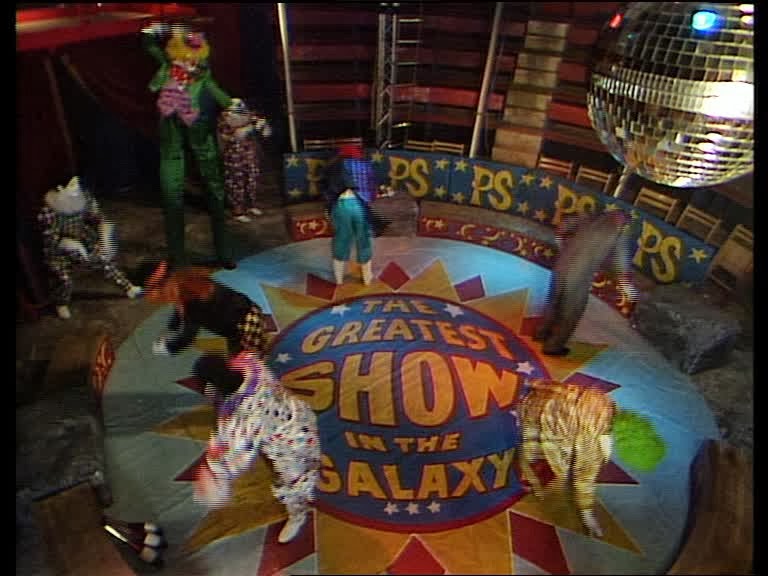
I think that so far, without a doubt, this is the best Sylvester McCoy story. It is let down by the final episode which is rather impossible to follow and when you look at it closely doesn’t make a lot of sense, but all in all Steven Wyatt’s second story is creepy, full of great characters, well directed, well shot and achieves everything that ‘Paradise Towers’ was lacking in atmosphere.
It’s just a pity that episode four, or to be more exact the last 10-15 minutes of the story, is so bewildering. The reveal of the ‘Gods of Ragnarock’ is something of an anti-climax because
really, who are they? They don’t have a place in Doctor Who folklore yet the Doctor says he has been hunting them all through time, so that’s somewhat strange. The polystyrene circus in another dimension is not the most impressive set, well it isn’t when it crumbles, but the show was millimetres away from being cancelled so these things can easily be forgiven. But the events of the final episode need to be addressed because it really left this viewer mystified as to what had gone on.
Mags (Jessica Martin) and the Doctor.
King Pin has the medallion, which he needs to get to the Doctor in the ‘dark circus’. Now despite never discussing how this was to be done, the Doctor spends his time trying to entertain the Gods of Ragnarock whilst constantly looking at his watch as if  waiting for the appointed time at which the medallion is to arrive. Either that or he is worried about how long he can survive. He then points a sword which he created from nothing (well a small piece of metal he just happened to have) at the ground, in the ‘real’ dimension the medallion falls down the pit aimed at the eye, and it appears at the end of the sword. How was this pre-organised? Then the Gods fire at the Doctor and he uses the medallion to deflect the ‘laser beams’ (for want of a better word) back at the Gods and the circus itself. That was the plan?  I’m sorry maybe people were so taken by McCoy’s bag of magic tricks (most of which are achieved by trick photography although he is in his element here which is great to see) that they didn’t notice the illogical nature of the plot and the way it was all resolved.

The somewhat dodgy Gods of Ragnarock.
At the end of the day, no matter how good the story is the audience wants a good resolution that they can understand. The better the story, the more disappointing a dud resolution is and that’s exactly the case with ‘The Greatest Show in the Galaxy’.
The first three and a half episodes are the best stuff for a long time. The clowns, led by the amazing Ian Reddington are wonderfully creepy. TP McKenna’s Captain Cook is a truly superbly realised character, double-crossing, back stabbing, killed and then brought back to life. Jessica Martin as Mags is again perfect casting, I even liked the Whiz Kid (Gian Sammarco).

As sick as I am of quarries, I didn’t mind the location so much either. It suited the story. All in all the story is very enjoyable, creepy, with a magnificent atmosphere. The music by Mark Ayres is perfect and Alan Wareing’s direction is spot on, both first timers. Considering the production was nearly cancelled like ‘Shada’, and the studio worked was instead mounted in a tent in a car park, it just goes to show that working under duress can really bring a production team together to create something amazing. This was heading for full marks until the final episode. I
Ace puts a big robot out of action.
especially liked the ending to episode one, which is not the traditional ‘peril-style’ cliff-hanger, but instead a dilemma when Ace is asked by the Doctor ‘Are we going in or aren’t we’ as we hear screams coming from inside the circus. Also, a great effort from McCoy and Aldred, supported by a great guest cast.

8/10

Saturday, 19 October 2013

Silver Nemesis

Anton Differing.
Bleh. What total and utter bleh. I don’t know what to say, but this story is rubbish. The Cybermen are rubbish. Cricket glove hands and a fallibility not just to gold but to gold coins. Nazis? Totally superfluous to the plot, indulgent crap by writer Kevin Clarke who thankfully never wrote for Doctor Who again. Not his fault though that this story has a nearly identical plot with a carbon copy resolution to ‘Remembrance of the Daleks’. Andrew Cartmel, why did you let this through?

'Excellent'? No. Not even a little.

Fiona Walker as Peinforte.
This sudden mysteriousness of the Doctor is offset by the fact that McCoy is not very mysterious. I liked Lady Peinforte – beautifully cast, Fiona Walker was perfect. Anton Differing as De Flores, the Nazi, is hilarious as he doesn’t seem to know what his lines mean, let alone what the story is about. In fact the casting is great, but it doesn’t get them out because the script is utter shite and the story looks very very cheap. It’s supposed to be the 25th anniversary special for Pete’s sake! Not even the brilliance of the Dolores Gray cameo can save this.
It’s just a run around for three
The Nemesis statue.
episodes, with a lot of setups for jokes and amusing situations which would work in a sketch comedy show, but there’s no substance to this at all. Everyone wants the nemesis statue and they round around fields for three episodes trying to get it and then it destroys the Cyber-fleet. This Doctor likes destroying things it seems.
Delores Gray.
Nice shots of Ace up on the gantries in the factory shooting Cybermen with coins. Pity the idea Cybermen could be so easily killed in bollocks. I mean the whole thing features some great locations, but there is no substance to the story at ALL. Terence Dudley’s scripts have more to them. ‘Delta and the Bannerman’ had more to it. Pft.

1/10

Wednesday, 16 October 2013

Remembrance of the Daleks

I am at loss to explain what the Doctor is doing here.
This is held up as one of the best stories of Doctor Who. It’s quite good, especially if you can ignore McCulloch’s dreadful music and the appalling title which means absolutely nothing, but it also left me feeling a bit unhappy about a few things. McCoy, in my mind, still seems to be going through the motions and the way he deliberately rolls his ‘r’s and over-pronounces some words to be honest is a bit much and I really feel he’s not in character, but at least he’s a far cry from ‘Time and the Rani’ where he seemed desperate to be funny.
Dursely McLinden as Mike Smith
The Daleks are back, and following on from ‘Revelation of the Daleks’, we have two factions, one headed by Davros now going by the guise of the Emperor Dalek, and the other headed by the Black Dalek controlling a young girl. Why? Because why not I guess. There’s great pace and energy through the four episodes, penned by first-time Who writer Ben Aaronovitch. Pamela Salem (Toos in ‘Robots of Death’) is just one of many quality actors recruited for this tale with deliberate nods to the past and very much a UNIT feel. We also have Michael Sheard returning to who as the Headmaster.
The Doctor with Gilmore and Rachel Jensen (Pamela Salem)
We see Daleks rising up stairs for the first time, a space shuttle actually land on Earth without any CSO, and the biggest explosion in Who-history. I think if you don’t delve too deep below the surface this is an almost perfect Doctor Who. However, it’s not.
The character of the Doctor, for starters, is too dark. To intentionally programme the Hand of Omega, which he calls a ‘stellar manipulator’ (oh Pu-lease!) to destroy Skaro’s sun, taking Skaro and other planets along with it, that is not something the Doctor would do in my book.
Maybe the Thals have died out, I don’t know, but still it’s very harsh to destroy a world. The Omega device appears to go forwards in time, but it’s all a bit confusing really. Cartmel and McCoy made a decision to make the Doctor darker, suggesting he had something to do with the days of Rassilon and Omega too. It flies in the face of who the Doctor has been up until now. Not to mention McCoy is not very convincing as a ‘dark character’, in my opinion. Mind you, I prefer it to his clowning around.
Inside a Dalek. Ewwww!
I really liked the use of nods to the past. In ‘Attack of the Cybermen’ the nods to the past were convoluted and confusing, yet important to the plot. Here, Totter’s Lane, the Coal Hill School, mentions of Zygons and Yeti, and even what appears to be Doctor Who about to be aired on BBC One, are incidental to the plot so the casual viewer might not know they were even there, and if they did and didn’t get them, it didn’t matter. For the fan though, they were nice touches.
The Black Dalek, Radcliffe and 'the girl'.
Ace makes a good impression, very different companion even if she is a bit much at times. The series is the better for her introduction. This story feels a lot more like Doctor Who than any of the previous season which is an interesting choice. We seemed to be going in a different direction in Season24, but season 25 sees more of a traditional feel in its opening instalment.
Where there's Daleks, there's always Davros it seems.
This feels like just about the most expensive Doctor Who story to date. A Dalek shuttle which is actual sizes that was lowered by a crane, some pretty awesome explosions, a high proportion of the story shot on OB. It’s only let down by one or two things, such as the music (especially) and the use of a lightning ball as the ‘time manipulator’. And the idea that the Doctor set a trap for the Daleks prior to November 1963 even though in ‘The Daleks’ he had never met them before.
But Doctor Who tales aren’t supposed to make perfect sense right? And we get some awesome scenes of Daleks exploding and the organic matter that is inside. Oh another returning face – Peter Halliday as the blind priest, I wonder if the casting was deliberately nodding to the past. Moving the coffin with the Hand of Omega though, that seems unnecessary and perhaps was just an idea for a scene that Aaronovitch wanted included.
Andrew Morgan makes a much better fist of this tale too which is good for him. I do wonder about its status as an absolute classic though, maybe fans are just agog at the explosions and so many Daleks in London. Great story though.

7.5/10

Tuesday, 15 October 2013

Dragonfire

After the worst first three stories a season has ever had to endure, at least ‘Dragonfire’ was an improvement. It’s saying something about 1987 Doctor Who that this is clearly the best story of the four, especially as it still includes some pretty dodgy bits including the Doctor dangling over a cliff holding on to his umbrella for no reason at all apart from trying to make a joke on the term ‘cliff-hanger’.
Edward Peel as Kane
We have a great villain at least – Edward Peel’s Kane is chilling in more ways than one. The dragon, apart from the legs, looks pretty good too and some of the ice sets look very good. Sadly some look very plastic but we can’t expect perfection can we, especially not in this season, which is clearly the worst in the shows history – that I’ve viewed that is, I hope it doesn’t get worse than this! The death scene of Kane exposing himself to sunlight and melting is one of the most impressive effects seen in Doctor Who in the first 24 years, I have to tip my head to the production team for that. Very much like Indiana Jones (Raiders of the Lost Ark).
The story is at least darker than the previous tale, and it is helped by the score provided by Dominic
Bonnie Langford, Tony Selby, Sophie Aldred and Sylvester McCoy.
Glynn, who provided the music for much of the previous season and seemed to have a much better idea of what was required than Keff McCulloch. It’s very grand, a great use of organ sounds.
We have the return of one of the best characters from Season 23 in Glitz, played by Tony Selby. He slips right back into character very easily as the loveably rogue, and you can’t help but think he would have worked well as a companion, especially with Colin Baker’s Doctor. That would have worked very well. He works well with McCoy as well, but as a pair I think the Sixth Doctor and Glitz would have taken the show somewhere new and exciting.
Ace's room on Iceworld
We have a new writer on ‘Dragonfire’, Ian Briggs. He turns in three solid episodes which are paced very nicely. The move to three-part stories is a good one, and strange that it wasn’t trialled before. I suspect the way that the budget was drawn up is why – John Nathan Turner had a budget decreed by the BBC for three stories over 14 episodes. Two four-parters and a six parter. He split the budget into two-three parters by using the OB budget for one and the studio budget for the other, hence ‘Delta and the Bannerman’ was almost completely OB save one short TARDIS scene, and ‘Dragonfire’ was completely studio-bound. This pattern would continue for the following two years.
The dragon reveals the treasure.
A story like ‘Dragonfire’ could only have been done in studio. Although some parts of the frostly set are rather dodgy, generally the feel is conveyed even if you see polystyrene here there and everywhere.  This is the final story for Mel (Bonnie Langford) and the first story for Ace (Sophie Aldred).
Kane's face peels away :)
Unfortunately the writers and script editor never had a mind to do something with Mel. We hadn’t seen much of her before this series and they could have revealed more about the character, introduced a few twists, cut back on the screaming but it seems nobody wanted to sadly. In the end we get her screaming her lungs out at every opportunity and being rather generic for the rest of the time. Cartmel appears to have wanted as much of a clean slate as possible to work from, and so the introduction of Ace is the first big step in the changing of the series.
Sophie Aldred adds a great bouncy (but different) energy to the show, being somewhat aggressive and having a penchant for blowing things up. However, it’s very hard to buy that Ace is only 16 years old, even if Sophie Aldred does look youthful for her age. Which she does.
Ian Briggs does leave a few holes in the script. The mother of the little girl Stella, (Stella is a child that runs around and hides for much of the story, very incidental but a nice touch) seems to not care about the ship with all the others shoppers on it being destroyed or consider the possibility Stella might be on board. That was a bit odd I thought. Kane’s been waiting in Iceworld for 3000 years and couldn’t solve the puzzle of the Drogonfire? Pu – lease! But you know, this is Doctor Who, right?
Far from perfect, but far from a turkey too.

6.5/10