Showing posts with label science fiction. Show all posts

Wednesday, 23 October 2013

Ghostlight

The Doctor and Ace meet Redvers Fenn Cooper
Marc Platt had apparently been trying to get a gig as a Doctor Who writer for some time, and finally in the 26th season of the show, he got his chance with ‘Ghostlight’, after his initial submission proved unworkable (a story set on Gallifrey called ‘Lungbarrow’).
‘Ghostlight’ is a very different story again from the rest of the season, the rest of the McCoy era, and indeed Doctor Who in general. In my opinion, this is clearly the best Sylvester McCoy story of all, with only two issues. One – Sylvester McCoy is generally excellent through
John Nettleton as the Reverend Ernest Matthews.

Katherine Schlelsinger as Gwendoline
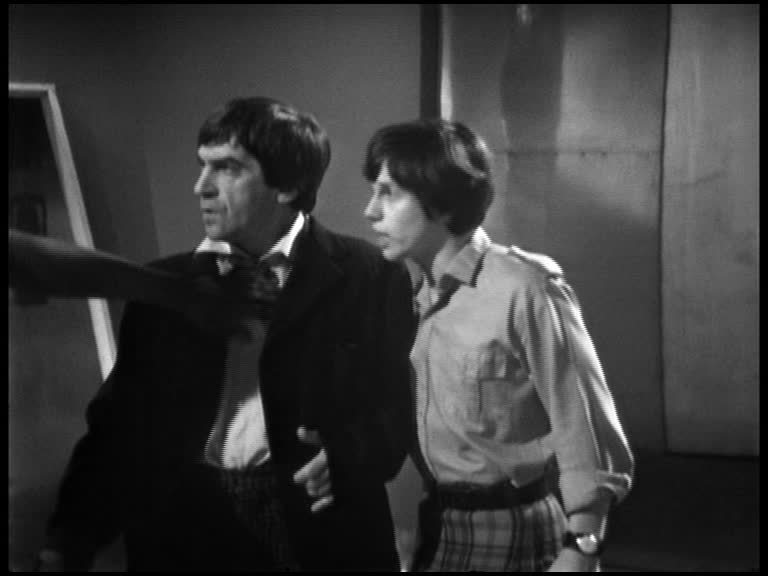
the three episodes, however in the final episode there’s a moment where he tells Light to leave Earth, and to be frank I’m not sure what he’s doing. Whenever he has to act really angry he screws up his face, holds out a hand and loses the audience. It’s a bizarre step out of the world he is in to what appears to be some desperate acting. Alan Wareing should have been on to that and reshot it at the very least, but it remains in there for all to see. It’s not the only time he’s done something like that, but this stands out because generally the rest of the story is McCoy at his best, playing games with Ace and being mysterious.
My second issue is with the picture quality. There wasn’t much that could be done when making the DVD, sadly most of the original video tapes with original footage were wiped so they couldn’t remaster them particularly. They had to work off the finished product which does look like it’s down a generation or two. Remembering that in the days before digital TV to edit video you basically had to copy it and lose a generation. With ‘Ghostlight’ being such a low-lit story, the issues are compounded and there is a lot of grain for something not shot on film. Such is life, it doesn’t detract too much from the story.
Sophie Aldred as Ace
The story is about a survey team sent to Earth to catalogue life. We have the control subject – ‘Control’(Sharon Duce), and the survey – Josiah Samuel Smith (Ian Hogg). In charge of the survey we have ‘Light’. The idea is that Control stays the same, whilst Josiah evolves with the planet. Light is fed up with the constant evolution and decides to destroy Earth, but instead the ship is taken away from Earth and continues its search for life with Control and Redvers Fenn Cooper (Michael Cochrane) at the helm.
Ian Hogg (Josiah) mencaces Ace held back by Sylvia Syms
The plot is all there, but there was a lot of scenes cut for timing reasons which may have helped the plot to be clearer. Andrew Cartmel laughs at people who were confused on the DVD, but although I understand the thing, it is the sort of story which requires the audience to piece it all together to comprehend what is going on. For a young audience that would be hard. I think watching this story in one sitting is advisable too, allowing the viewer to connect threads throughout the three parts rather than desperately trying to remember things from the previous week (presuming they watched an episode a week as it was originally broadcast).
Having said that, there’s nothing wrong with a plot which requires effort from its audience at all. The music, although a little loud at times, is excellent, the house is very well done and the vision presented by the director is amazing. Wareing has really brought to life a Victorian house in Perivale, made it creepy and sinister, and his casting was impeccable. From John Hallam as Light down to Brenda Kempner as Mrs Grose, every character was played by the perfect person for the part.
John Hallam as Light
Being contained entirely within a house probably helped curtail the budget, but it meant that every little detail could be gotten right, and they did. This is a wonderful example of a story that unfolds, that peels itself piece by piece, to reveal a clever if somewhat confronting at times plot. We have the struggle between theories of life – religion versus evolution, although the story certainly is on the side of the evolutionist. Set in Victorian times, this was a hot issue on the tails of Darwin’s theories.

This story has no Daleks or Cybermen, no epic battles and no alien worlds. And it is the better for it. It shows that a strong cast, a strong director and a cracking script is all that is needed to produce a brilliant piece of Doctor Who.

9.5/10

Monday, 20 May 2013

The Tomb of the Cybermen

The tombs

So nice to view a story with no missing episodes. ‘The Tomb of the Cybermen’ is again supposed to be a ‘classic’ Doctor Who story, and was found in the early 1990s – in Hong Kong I am told! My friend Andrew remembers when it was found and very quickly was available to buy at Melbourne sci-fi/collectables shop ‘Minotaur’ in video form. How exciting it must have been! It seems unlikely whole stories will ever turn up again, but I guess Doctor Who fans can only hope.
The Doctor meets Cleeg.

I will start with the DVD presentation. The remastering and vid-firing of ‘The Tomb of the Cybermen’ is absolutely brilliant! I can’t remember a story that looks so clean and sharp! The DVD crew have done a magnificent job with this one. Generally, with the exception of ‘The Moonbase’, I have found the (existing) Troughton episodes to be clearer and sharper than the Hartnell episodes, but this is glorious!
Enough of that though. It’s great to see a Cybermen story which is not a clone of ‘The Tenth Planet’, although there are still some trade-mark concepts ingrained in this story reminiscent of the previous two Cybermen stories. It’s a twist on the ‘base-under-siege’ storyline used twice already. Again people from various countries with various degrees of convincing (or not so) accents are stranded fighting the Cybermen. This time though, it’s not the Cybermen coming to Earth, rather the humans have travelled to the new Cybermen home planet, ‘Telos’, to seek out the Cybermen.
We open on Telos, (a gravel pit somewhere in England naturally) and an exploration group finds a couple of doors in a cliff face – this is the tomb of the Cybermen. It starts with a rather B-grade science fiction opening, with stock music to match. The Doctor, Victoria and Jamie arrive and into the tomb they go.
Michael Kilgariff as the Cyber-controller
The Doctor (Patrick Troughton) has some curious motives in this one. He could have left well alone, but decided not only to join the party, but to solve the logic puzzles that allow the Cybermen to be found and consequently woken by Cleeg. Cleeg (George Pastell) has an East European accent, and is the quintessential mad scientist. All the logic stuff went right over my head, but I presume it all makes sense as Kit Pedler felt it was important that this sort of stuff did.
Thereafter there is much to comment on plot-wise. The Cybermen get thawed out, and declare to the humans ‘you will be like us’. A wonderful line, and the Cybermen voices are much clearer than they were in ‘The Moonbase’, but this may be because the audio has been cleaned up to a higher standard.
It’s very well done really, for the time period. It’s only four episodes as well, which means it moves a lot faster than ‘Evil of the Daleks’ ever did. Morris Barry was the director and he did a fine job of conveying the feeling of claustrophobia that visiting a tomb in a cliff face must give. We have the introduction of the cute little Cybermats, who don’t seem to do all that much but get shot by some very accurate shots (well done Victoria!).
Deborah Watling (Victoria) gets a chance to get some proper screen time in this story, and shares a wonderful scene with Patrick Troughton’s Doctor where he talks about his family. Troughton is wonderful too in the whole story. Jamie (Frazer Hines) is strong as always. The guest cast are a mixed bunch. The two American characters, played by George Rubicek and Clive Merrison quite frankly are a bit poor. Their acting appears to be better suited to the stage, and their accents are less than convincing. Cyrill Shaps, in his first Doctor Who story, is the neurotic Professor Viner, nails the part perfectly.
The Doctor and Jami are, as always, great in this one.
Then we have Shirley Cooklin, Peter Bryant’s (the Producer at the time) wife, as Kaftan, another good performance. As for George Pastell as Cleeg, it was a wonderfully wonderfully over-the-top performance. I think.... Or did he go too far? He does have the classic evil-villain line in episode four, when he is about to kill the Doctor. ‘No wait! I have a better idea! A much better idea!’ How he delivered that without corpsing I do not know.
A lot of the story comes across as quite clichéd, I feel. I ask myself whether that’s only because I was viewing it more than forty years after it was made. I doubt the children watching in 1967 has seen anything like it at all!
The atmosphere is perfect, and despite the odd obvious appearance of Styrofoam, the sets and design, on the budget they had, is outstanding.
8/10

Monday, 11 March 2013

The Space Museum


This is the first story I have seen to really play around with time. I enjoyed many aspects of this story, and was a little underwhelmed by some others. I am assured by my most excellent friend Andrew, that this is a common thing when talking about this story!
Hello! That's us over there trapped in glass cases!

For those who haven’t seen it, the only talking characters in the first episode are the Doctor, Ian, Barbara and Vicki. They have arrived... before they have arrived! The TARDIS has slipped a track in time. They can’t touch anything, or hear or talk to anything. Thankfully walking is ok! They don't disappear into the ground. The museum is rather simple, but they discover themselves in glass cases as a museum exhibit. The remaining three episodes will have them desperately trying to avoid this future!
It’s a great set up, and no doubt the original audience had their interested more than well and truly pricked. However, what followed perhaps does not live up to what was promised. I watched this on one of your Earth DVDs, and also watched a piece by Rob Shearman on ‘Defending the Space Museum’. He suggested that the last three episodes are a basically a satire of the series, that it is all tongue in cheek.
The Morox were at least given interesting hair!

Either that or no-one really cared to put much time, money and effort into it. As Rob said, even the computer that guards the weapons’ store sounds bored. The production notes proudly tell of how they ran the serial well under budget, and it shows. There are no frills here on this plain, dull planet.
The first issue is that we get no sense of the planet beyond the space museum. It seems unlikely that a space museum that no one visits is basically the whole planet, yet everything seems centred around it. The writer, Glynn Jones has not taken the time nor effort to imagine what the world is like beyond the museum, so when he writes about rebels overthrowing their oppressors, and then they win and over throw them in the space of half an episode, well it’s not even vaguely believable.

The locals and their wonderful eyebrows.
No characters outside the Doctor, Ian and Vicki (Barbara has precious little to do in this one) are worth caring about. There’s no thought been put into any of the characters. Then the costume designer steps in and decides that all locals just wear black skivvies and have very bizarre eyebrows. The poor actors have had their eyebrows poorly covered with face make up and new ones drawn a centimetre higher. It looks bizarre and not slightly convincing.


The sets are all white walls with whatever bric-a-brac is lying around. They did a great job in saving money I expect but expressed nothing artistically in the look of the thing. The actors are all so bored with the one-dimensional characters they have been given nothing stands out at all.
Vicki plots revolution, to raised eyebrows! (lol - gosh I make myself laugh!)

Having ranted a bit, it’s not the worst bit of TV ever made, just very uninspiring.  It is watchable, but very hard to sit through the last three parts. Vicki (Maureen O'Brien) gets a decent part in this one at least. She defeats the bored computer and starts a revolution! Her energy and positivity towards the role is always unquestionable. In a rather dull story, she is the shining light!
4/10

Monday, 4 March 2013

The Romans


I have to say, this is my favourite Doctor Who tale so far! I found ‘The Roman’s’ to be a highly entertaining four episodes with a fair deal of comedy thrown in for good measure. It’s interesting and a lot of fun – and the cast members seem to be having a fair bit of fun themselves.
The Doctor, Vicki, Barbara and Ian enjoy a relaxing, lighter moment.


William Hartnell and the gentle art of fisticuffs.
The first episode ‘The Slave Traders’ is a very strong start, and the cast member who really shines is William Hartnell. He is really on song in this episode and doesn’t miss a beat. The same can’t be said for the remaining episodes where he appears to be really struggling at times, but nevertheless the first episode is his highlight thus far. It’s great to have Maureen O’brien in as his sidekick too – she does a wonderful job, is bubbly and intensely interested and amused by what the goings on. Quite the opposite of Susan.
 
William Hartnell in the title role has a ball. He even gets into a fight with a mute, and kicks his pants! There's an awful lot of hitting people over the head with vases - Barbara even knocks Ian on the scone.


Ian rows for his life in a slace Galley Boat.
Barbara and Ian each have separate storylines after being sold as slaves which are quite interesting. As in ‘The Dalek Invasion of Earth’, Ian (William Russel) finds himself paired with another similarly aged man, Delos (Peter Diamond). Ian leads the way here too, and the pairing works well. Barbara has less funny being chased by Nero (played by Derek Francis, who is excellent) and seems to always be the character who has to endure unwanted sexual advances (such as in ‘The Keys of Marinus’).


Highlights of this story include the Doctor pretending to play the Lyre, doing a whole ‘Emperor’s New Clothes’ scene, and again William Hartnell in general showing glee in giving Nero the idea to burn Rome. Barbara and Ian have some wonderful moments in the first and last episodes in the villa they are ‘borrowing’.


Less impressive stuff? Well there’s a scene in episode two or three when two gladiators are practicing in a courtyard and they go at each other with the enthusiasm of a sleeping grandmother. Then we have the cut at the end of episode two where Ian looks out his cel window to see lions outside – clearly stock shots from a circus or zoo, or both! Not to forget when Ian and Delos are inside the galley, a well made set, they appear to have a bucket of water thrown over them from behind the camera instead of it coming from through the oar holes! Also, after episode one, despite a wonderful portrayal, William Hartnell does seem to really struggle on his lines for the remaining three parts. This was probably as bas as he's been thus far.

The limitations are a bit obvious, but despite them the story is effectively told. The sets belie the limited studio space, but also show what could be done. Simple, but very effective use of curtains and more curtains, balconies and columns equals authentic Nero-era Rome! J


The recycling of cast members is a little more puzzling. The rogue who is dealing in the slave trade suddenly appears as the captain of Nero’s guard! If so why did he need to sell Barbara to Nero via a third agent?


The models at the end when Rome is burning are rather well done. It’s hard to criticise the design when money and space were so scarce. It was interesting to learn that this story was in production around the time ‘Carry On Cleo’ was released in cinemas. Dennis Spooner, the writer, seems to have written a few gags and situations that wouldn’t have gone amiss in the Carry On series!  I enjoyed the comic turn however, and thankfully he didn’t set too much of this one in prison cells (unlike his previous entry, ‘The Reign of Terror’.)

I can honestly say I think this is the best story so far.


9/10

Sunday, 24 February 2013

Planet of Giants


Would I be the only one who found the title misleading to this new Doctor Who adventure/Susan scream fest? I mean, the Doctor and his company are shrunk down to the size of an inch, whereas all the other characters are normal size. So there are no actual giants. To be honest, I was disappointed.

On the other hand, a tricky concept to pull off and I think the production mostly succeeded in this story. Very big props were made for the actors to cart about and the giant-sized sets were excellent, I don’t think anyone could disagree with that. It’s just a pity that the storyline was a bit naff.

The soundtrack was very interesting I thought. Very much of the time. This was a rare case of the Doctor, Ian and Barbara possibly returning to their own time on Earth, but nothing is made of that at all despite Ian and Barbara desperately wanting to go home. Instead of the production team making something set in the far past or future, this story is very clearly ‘the early 60s’ in its design, its look and its feel. It felt very strange after watching the first eight stories, it was nothing like them.

 
And the Doctor etc etc don’t for a second really interact with the other characters, which makes two separate plots basically. There is the storyline concerning the nasty Alan Tilvern (Forester) who is happy to make money from an insecticide that will kill almost anything in its path. He shoots a man from the ministry and spends the three episodes trying to cover it up, with the aid of the scientist who invented the insecticide, and the storyline following the Doctor and his companions.

Once again, due to little more than curiosity, they find themselves separated from the TARDIS. Their only goal really is to get back there, alive. Barbara is infected by the insecticide when she handles a grain doused in the stuff, and for some reason tells no one about it for ages! A very odd thing to do really, there was no real motive behind it.
 

Credit where credit is due, the design, the sets, the props are all fantastic. A lot of work went into that aspect of the story. If it was going to interest or convince anyone, then they needed to be good and they were. I have learnt through my friend Andrew who seems to know a lot about this mysterious series that there was originally four episodes, and the squashed episodes three and four together because it didn’t sustain enough pace for four full episodes. I could see a case for making it only two to be honest! Nevertheless, it was far from all-bad. Well-directed, but the plot-line is simply too thin to sustain the story. Lack of interactions between the Doctor, his companions and the other characters limited dialogue, although it is an interesting way to do a story, with the other characters not even aware of the Doctor’s existence. The first time they’ve tried that.

For it to sustain three or four episodes, perhaps more characters are needed. You could still keep the split in the action, but the storyline external to the Doctor and co. needed a bit more intrigue.

An interesting study of what it’s like to affect an environment, a situation, without direct communication nor interaction with it.


4.5/10

Friday, 22 February 2013

The Reign of Terror


Well. What a place for the Doctor and his companions to land. Final story of the (transmitted, my friend Andrew put me straight) first Doctor Who season, and they arrive in the middle of the French Revolution. RIGHT in it. Sorry, was just dying to say that.

I avoid these periods of Earth’s history if I can. They are bleak and depressing, dangerous and all in black and white. I only had one black and white adventure – it was my first. Then I moved on from that! Colour suits me much better and I am surprised the Doctor hasn’t given colour a go to be perfectly honest.

Again, as appears to be the tradition, the first episode concentrates on the Doctor and his friends. They discover their surrounds, find a barn, a kid, and nearly get burned in the process. It’s a pretty good opening all told, but straight away we appear to be in for a bit of a grim tail. The sets, though limited, seem very authentic, and they found a good child actor there as well. Costumes look very good too, much more authentic than the Aztec ones.

People are already getting killed left right and centre, and Barbara, Susan and Ian are swept off to the Concergerie prison in Paris. The Doctor is saved by the kid. This is where the story goes a bit wonky. I understand that this was made in some very small studios, and the sets bear that out. The Paris streets are little more than alleyways, everything feels cramped throughout this story.

Also, the decision to set almost half of the six episodes inside a dirty old French prison may have saved a few pounds but does nothing to make the story exciting. I was expecting they would move on from there, but from episode two to episode six they keep landing themselves back in the prison. Susan is in fine whining, screaming and crying form, especially when confronted by rats that aren’t even there! It’s a mercy to the audience that she gets sick and barely features in the second half of the tale.

The writer, Dennis Spooner, must have been a fan of the Carry On films. He wrote a number of comedic characters into the story like the stupid-beyond-stupid jailer and the leader of the road gang who the Doctor smacks on the back of the head with a shovel in a surprisingly violent act. You wouldn’t catch THIS Time Lord being so brutal. Probably. Actually even my friend Andrew felt this was rather alarming and went a bit too far.

The Doctor though appears to enjoy the story enormously, changing into fancy dress and the like and impersonating a leader from one of the provinces. Dennis Spooner gave him plenty to do. Like Carry On – Don’t Lose Your Head, this story is very British. Again it refers to the Scarlett Pimpernel – or at least people doing what he was reputed to have done in helping French Aristocrats to escape from France. I was watching on one of the DVD things and there were pointers and explanations shown at the bottom of the screen and it seems it must be fiction because many things didn’t actually happen, or at that time.

Then the strangest thing happens. The Doctor, his companions and the entire cast not to mention the sets are somehow changed into cartoons. It is not explained, nor is the fact that they change back at the start of the final episode. Why would this happen? What celestial force has the power to do such a thing? I was very confused.

In fact I had an adventure where I was turned into a cartoon, in a place called ‘Cartoon Land’. It was very unpleasant and I don’t recommend it. However, at least my head stayed normal!

‘The Reign of Terror’ had a lot of potential in my eyes, but it fell a bit short in the end. The sets were well done but the lack of space in the studio really hurt this story, it limited what the writer could do and where he could take the characters, and gave a very cramped feel to the story. Yet they still put a horse in the studio! It’s a barmy world sometimes!


6/10
 

Wednesday, 20 February 2013

The Aztecs

Well it seems this Doctor and his friends keep alternating from future to the past. This time they head back to the Aztec civilisation in Mexico and get up to all sorts of larks. Written by Mr John Lucarotti, who wrote 'Marco Polo'.
So I sat back and watched. Very quickly the Doctor and Barbara etc are separated from the TARDIS. In fact, they spend the whole story trying to get back to it. It seems to be the entire plotline of the adventure. Interesting idea - wait, wasn't that the idea behind 'Marco Polo' as well?

Anyways, onto the story. Once I'd got past Susan and her emotions, she was shifted away and hardly appeared in episodes two and three. What a mercy. Interesting character thread for her and Barbara in this one. She defiantly says she won't marry the 'perfect sacrifice'. This is akin to her outrage at Ping Cho's betrothal in 'Marco Polo'. I find it interesting as the Doctor at this time is accepting of other culture's practices and the like, but he clearly has not instilled that in Susan.
Surely she would know this sort of defiance gets her nowhere?
Oh well.
The evil Tloxocl and Barbara.

Barbara on the other hand takes the lead in the story pretending to be Ytaxca. Jaqueline Hill is a tower of strength in this, a wonderful performance. She is pitted against Tlotoxcl who is very evilly played by John Ringham. She wants to change the course of history. The Doctor tells her she can't rewrite history, 'not one line'. He's right there, tried it myself and failed too often I must say.
To balance Tlotoxcl, we have Autloc, played by Keith Pyott. I enjoyed this performance, a wonderful, humble character well portrayed indeed. And as Cameca, Margaret Van Der Burgh, another wonderfully honest performance. I think the acting is to be highly commended all round.

Cameca is the Doctor's love interest in this story, but it's not to be. I'm sure though that most stories the Doctor will have a dalience or two. I had one once, two in fact. Twice this ol Professor here has fallen in love, both times it ended in tragedy and death :( At least Cameca was spared that fate.

Ian is busy with his own personal feud with Ixta, a might warrior played by Ian Cullen. This is a secondary struggle to Barbara and Tlotoxcl, but interesting and rather testosterone pumped! I think all the main characters had a lot to do in this one, and all had personal journies to fulfill. This made it quite an interesting story to watch. Even if the costumes were not accurate at all. I know, I visited Mexico at a similar time myself but managed to stay more in cognito than these guys!
All round for the four regulars - well done!


I expect next I will be taken to a story set in the future or at least on an alien planet. I wonder if it will be anywhere I know....

7.5/10

Tuesday, 19 February 2013

The Keys of Marinus


My journey into the worlds of this strange Time Lord who isn't me but has a similar name continued with this six part story called 'The Keys of Marinus'. Six seemed a nicer number than seven = not so long!
The Doctor, Ian, Barbara and screaming Susan arrive on the world of Marinus, escape a lot of deep-sea divers who seem to be hostile for some reason and and very quickly sent on a quest to find keys to this machine by some old guy who's contract didn't seem to stretch past the first episode.

It was a funny story, credited to this 'Terry Nation' chap who wrote that encounter with the Daleks, and I started to wonder if the TV series was actually nothing more than fiction. Interestingly enough this story hopped from place to place, rarely spending much more than an episode anywhere.
I could tell it really was a TV series because the sets seemed to lack a certain something.... money, I think that was what was lacking!
Brains in cases, no walls to be seen. = Money saver!
 

Soon they pick up a couple of others looking for the keys when they land in a world ruled by talking brains in glass casings. That set lacked... walls. An interesting twist on reality when they have their minds effected and everything seems perfect when in fact it's the opposite. My favourite episode of the pipece I think was this episode two, although it lacked background music. And walls at times.

Then we are in the screaming jungle. The Doctor disappears for two episodes, and we have an episode entirely set around a lot of vines and another overacting old fella. This is left to Ian and Barbara to solve, meaning Susan gets to shriek a bit but then moves on for half the episode which is nice. But it's rather dull and nothing much happens.

Episode four puts us into a land of snow, ice and general freezingness. And a yucky man - not so old but not so young - who takes a fancy to Barbara in a scene I felt very uncomfortable watching. I heard somewhere this was supposed to be a kids show. Who are they kidding? (boom boom!)

Ice and snow are very hard to do convincingly on a budget, but hell they did them anyways. Badly. And then Ian is suddenly accused of murder!

Episode Five and they are all reunited with the Doctor, who has the job of defending Ian for killing a guard and stealing the final key of Marinus in the city of Mellenius or something. This episode and the last feature judges in wonderful hats, and poses the question - how would justive work if people were presumed guilty before being proved innocent? Something in that for everyone I thinks!
Interesting telephones and a jealous and evil wife are not enough to stop the Doctor and co, and episode six sees them return to where they started.

However, now the diving instructors, called Voords, have control of the machine. Ian is a smart cookie and switches a fake key for the real last key though. The Doctor and Co. escape just as the machine blows up, killing the Voords. And I ask, Ian is the hero? So what do they need a Time Lord for?

It's an okay story with good and bad points. Can't wait to see what they get up to next!
The Professor, signing off with a 5/10.

Monday, 18 February 2013

Marco Polo


Well, finally of that TARDIS goes the Doctor and he’s back on Earth. It seems these episodes were engulfed by the time vortex! They don’t exist anymore as moving pictures! The time vortex is a cruel beast that ways, some of my earliest adventures such as ‘The Man-Eater’ and ‘Nature Walk’ have disappeared into time and space never to be seen again. Very sad indeed.

However, this has some sort of reconstruction I saw on the DVD that I bought in the future on ebay for a fraction of the actual cost of today as I blog. In fact I got the whole series. And with a series of blurry photos and some of the surviving soundtrack I could follow this story, apparently 7 parts but on DVD only 31 minutes!

That’s a mercy! So the Doctor and his crew have an issue with the TARDIS getting to cold. How bizarre. Wouldn’t happen if they took better care of it! They meet Marco Polo, a famous traveller from Venice who’s going along the silk road to China, called Cathay back in the time. I went to China once where I met the evil Nhim Sie Hou, but it turned out this Tegana fellow was even shiftier!

They also travelled with Ping Cho, a lady to be married to a man of 70 she had never met. Susan wasn’t so rapt at that thought. She told her what’s for and Ping Cho realised she didn’t really want to marry the chap.

Meanwhile, Marco Polo wants to give the TARDIS to Genghis Khan in the hope he will be allowed home. But Tegana wants war. They travel a heck of a long way in this one, thousands of miles, and never leave the studio. Impressive stuff! All they really want is the TARDIS back so they can bugger off, but every time they get close something goes awry!
 

For seven parts based on such a thin premise, the story holds up extraordinarily well. The actors, especially the supporting cast do a great job, and there appears to be less of Susan’s whining, crying and screaming. Why the Doctor doesn’t just drop her off somewhere and not come I don’t know. A very clever idea for a story, and well paced over seven episodes (in fact I went to this youtube place where I saw a full, colourised version!). Nicely done.


8/10